
Hi, this is a comment. To get started with moderating, editing, and deleting comments, please visit the Comments screen in…
Mineral Processing:
A Definitive Guide to Modern Ore Beneficiation
The journey from raw ore to high-value concentrate is
a complex, high-stakes process where profitability is won

The journey from raw ore to high-value concentrate is a complex, high-stakes process where profitability is won and environmental legacy is defined. For many, navigating the dense jargon and intricate flowsheets of modern mineral processing feels like an insurmountable challenge, obscuring the critical link between operational choices and financial outcomes. The perception of an opaque, legacy-driven industry often masks the immense potential for data-driven optimization and technological advancement.
This definitive guide demystifies that complexity. We dissect the critical stages of ore beneficiation, from the brute force of comminution to the precision of flotation and hydrometallurgy. You will gain an end-to-end understanding of the process, enabling you to identify key areas for efficiency gains. Furthermore, we will illuminate the technological frontier-exploring how predictive intelligence and automation are revolutionizing recovery rates, minimizing waste, and unlocking unprecedented value. Consider this your blueprint for mastering the fundamentals and making strategic investments in the future of mineral extraction.
Core Objectives: The ‘Why’ Behind Mineral Processing
Mineral processing, or beneficiation, is the critical intermediate stage between mining and extractive metallurgy. It is an industrial science dedicated to the physical and chemical treatment of raw ore to increase the concentration of valuable minerals. The fundamental economic imperative is to transform vast quantities of low-grade, run-of-mine material into a marketable, high-grade concentrate suitable for downstream refining. For a comprehensive Mineral Processing Overview, this field encompasses a sequence of engineered operations. Each unique ore body requires a bespoke strategy, or ‘flowsheet,’ which serves as the definitive roadmap for the processing plant, dictating the technology and sequence required for optimal value extraction.
The Goal of Liberation
The first and most critical objective in any mineral processing circuit is liberation. This is the process of breaking down ore to a particle size where valuable mineral grains are physically detached from the worthless host rock, known as gangue. Achieving the correct particle size is a strategic trade-off; insufficient grinding leads to incomplete liberation, a primary cause of mineral loss to the waste stream. Conversely, over-grinding consumes excessive energy a major operational cost and can create ultra-fine particles that complicate subsequent separation stages.
The Principle of Separation
Once valuable minerals are liberated, they must be separated from the gangue. This stage exploits the distinct physical or chemical properties between the target minerals and waste particles. The selection of a separation technique is entirely dependent on these differential properties, which can include:
-
Density: Utilizing gravity or centrifugal force to separate heavy minerals from lighter ones.
-
Magnetism: Isolating magnetic minerals like magnetite from a non-magnetic gangue.
-
Surface Chemistry: Modifying particle surfaces to make them hydrophobic (water-repelling) or hydrophilic (water-attracting) for froth flotation.
The two products of this process are the concentrate, which contains the high-value minerals, and the tailings, the waste stream sent for disposal.
The Value of Concentration
The ultimate measure of success is the degree of concentration achieved. The ‘ratio of concentration’-the ratio of the mass of the initial ore to the mass of the final concentrate is a direct driver of profitability. A high-grade concentrate significantly reduces transportation and smelting costs, as less energy and fewer reagents are needed to process a smaller volume of material. For example, a plant might process 100 tonnes of 1% copper ore to produce just 3 tonnes of a 30% copper concentrate. Alongside this, the recovery rate, which measures the percentage of the valuable mineral from the ore that is captured in the concentrate, stands as a primary key performance indicator (KPI) for circuit efficiency.
The Modern Mineral Processing Flowsheet: From ROM to Concentrate
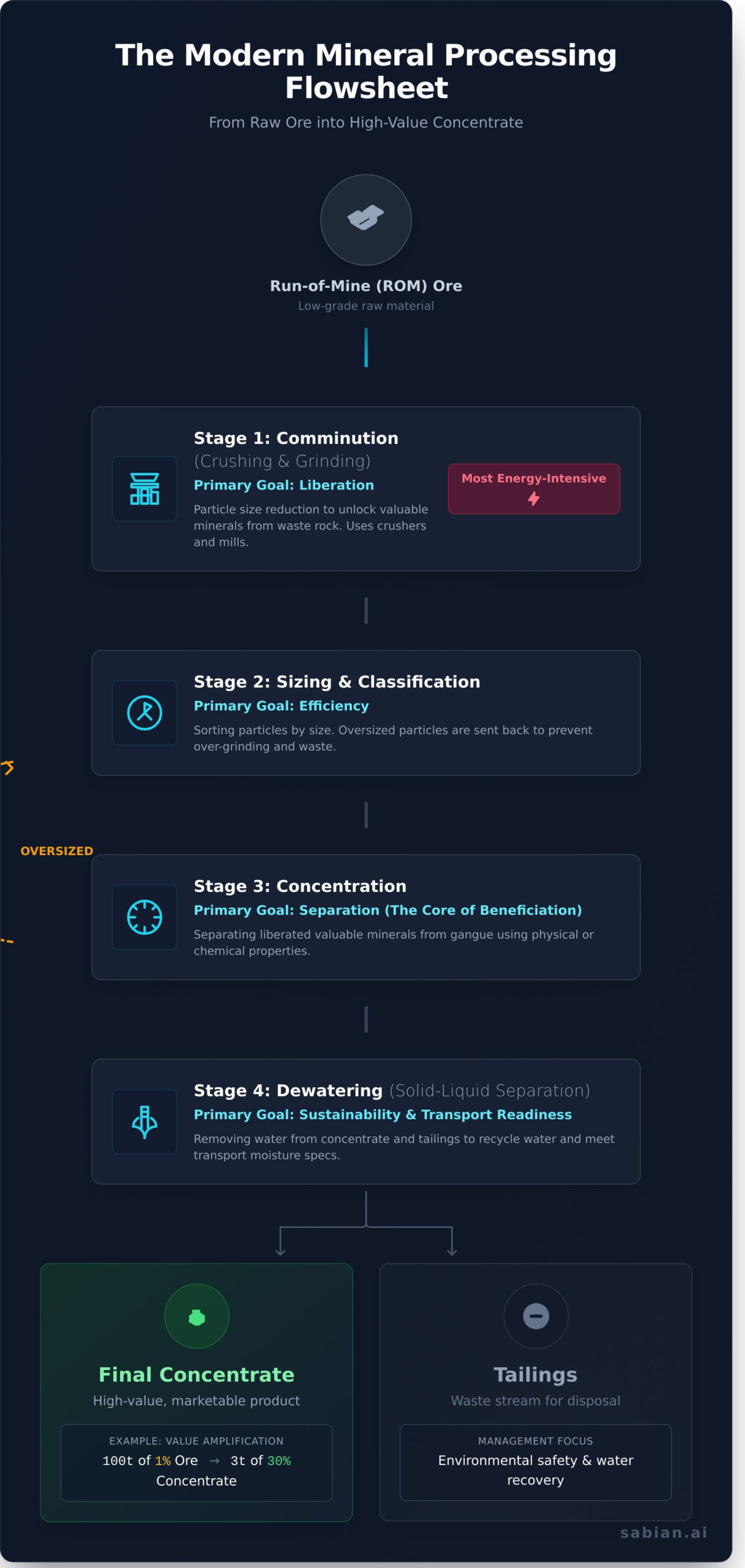
A modern mineral processing flowsheet is a highly engineered, sequential system designed to transform raw Run of Mine (ROM) ore into a marketable concentrate. Think of it as an industrial-scale kitchen: you must first prepare and sort your ingredients (the ore) before you can execute the main recipe (concentration). Each stage is precisely calibrated to prepare the material for the next, forming an interdependent chain where the efficiency of one step directly impacts all subsequent operations.
**[ROM Ore]** → Comminution → Sizing & Classification → Concentration → Dewatering → **[Final Concentrate]**
While this four-stage framework is universal, the specific equipment and parameters are meticulously selected based on the ore’s unique mineralogy, grade, and physical characteristics. A flowsheet for a copper porphyry deposit will look vastly different from one designed for iron ore or lithium-bearing brines.
Stage 1: Comminution (Crushing & Grinding)
Comminution is the process of particle size reduction. Its primary goal is *liberation *breaking down ore to physically expose and unlock the valuable mineral particles from the waste rock (gangue). This begins with coarse reduction via crushing (using jaw or cone crushers) and is followed by fine reduction through grinding (in large, rotating SAG or ball mills). This is, by a significant margin, the most energy-intensive stage in mining.
Stage 2: Sizing and Classification
After initial grinding, particles must be sorted by size to ensure efficient processing. Coarse particles are separated using screens, while fine particles are classified into size fractions using equipment like hydrocyclones, which use centrifugal force. This stage is critical for efficiency; it prevents energy waste by routing oversized particles back for further grinding while allowing correctly sized particles to advance, preventing over grinding and improving downstream recovery.
Stage 3: Concentration
This is the core of beneficiation, where the liberated valuable minerals are separated from the gangue. The method chosen is dictated by the mineral’s distinct physical or chemical properties. This can range from physical separation methods like gravity or magnetic separation to chemical methods like froth flotation. Optimizing this stage is the central challenge in modern ore processing, a topic extensively covered by organizations shaping the Future of Beneficiation. It is here where maximum value is either captured or irrevocably lost.
Stage 4: Dewatering (Solid-Liquid Separation)
The final stage involves removing water from both the concentrate and the tailings slurry. This is a multi-step process typically involving thickening (allowing solids to settle in large tanks), filtration (passing slurry through a filter medium), and sometimes drying. Effective dewatering is vital for producing a concentrate that meets moisture specifications for transport and for recycling water back into the circuit, a critical component of sustainable and cost-effective operations.
Key Concentration Techniques: Separating Value from Waste
Following comminution, the concentration stage is where the economic value of an ore is unlocked. This critical phase of mineral processing exploits the distinct physical and chemical properties of valuable minerals to separate them from the non-valuable gangue. The objective is to produce a high-grade concentrate for subsequent refining.
Modern processing plants rarely rely on a single method. Instead, they engineer complex circuits that combine multiple techniques in sequence. The selection and optimization of this flowsheet is a core discipline of metallurgical design, demanding precision and deep material knowledge to maximize recovery and economic efficiency.
Physical Separation Methods
These methods leverage inherent physical differences between mineral particles without altering their chemical structure. They are often the most cost-effective separation techniques when applicable.
-
Gravity Concentration: Exploits differences in specific gravity. Denser minerals are separated from lighter ones using equipment like spirals, shaking tables, and jigs. This method is ideal for heavy minerals such as gold, tungsten, and tin ores.
-
Magnetic Separation: Utilizes variations in magnetic susceptibility. High-intensity magnetic separators can extract weakly magnetic minerals, but the technique is most famously used to concentrate strongly magnetic iron ores like magnetite.
-
Electrostatic Separation: Differentiates minerals based on their electrical conductivity. It is a highly specialized technique used primarily in the processing of mineral sands to separate conductive minerals (e.g., ilmenite, rutile) from non-conductive ones (e.g., zircon).
Physicochemical Methods: Froth Flotation
Froth flotation is the most significant and widely used concentration method in the mineral processing industry. It is indispensable for treating finely ground, complex ores, particularly for base metals like copper, lead, and zinc, as well as critical minerals and rare earth elements. The process involves selectively modifying the surface chemistry of target minerals with chemical reagents, rendering them hydrophobic (water-repelling). When air is bubbled through the ore slurry, these hydrophobic particles attach to the bubbles and rise to the surface, forming a mineral-rich froth that is skimmed off for collection.
Hydrometallurgical Processes
Hydrometallurgy employs aqueous chemistry to extract and purify metals directly from ore or concentrate. This process is often integrated with or follows initial concentration steps. The primary sequence includes:
-
Leaching: The target metal is selectively dissolved from the ore using a chemical solution, or lixiviant. The most prominent example is the use of a cyanide solution to dissolve gold and silver.
-
Solvent Extraction (SX): The metal-rich solution from leaching is purified and concentrated by transferring the metal ions to a specific organic solvent, leaving impurities behind in the aqueous solution.
-
Electrowinning (EW): An electric current is passed through the purified, high-concentration solution, causing the pure metal to deposit onto cathodes, producing a final high-purity metal product like copper plate.
Critical Challenges Facing Modern Processing Plants
While the principles of mineral liberation are well established, the operational reality of modern mineral processing has become a complex battle against diminishing returns and escalating pressures. The industry is at an inflection point where incremental improvements are no longer sufficient. Today, operational viability depends on confronting a triad of interconnected challenges geological, economic, and societal that are the primary drivers for profound technological innovation.
Declining Ore Grades & Complex Geometallurgy
The era of high-grade, easily processed ore bodies is ending. As miners access deeper and more complex deposits, they face a fundamental reality: lower ore grades mean exponentially more material must be mined, crushed, and processed to yield the same unit of metal. This is compounded by increasing ore complexity. **Geometallurgy **the critical discipline of linking geological characteristics to metallurgical performance reveals that ore is not uniform. Unpredictable variations in hardness, mineralogy, and composition create a volatile feed, disrupting plant stability, reducing recovery rates, and making financial forecasting a high-risk endeavor.
Escalating Energy and Water Costs
The economic model of a processing plant is directly exposed to global resource volatility. The most significant pressures include:
-
Energy Consumption: Comminution (crushing and grinding) is intensely energy hungry, often accounting for up to 50% of a mine site’s total power consumption. In an era of rising energy prices, this represents a massive and unpredictable operational expenditure.
-
Water Scarcity: Water is not just for dust suppression; it is a critical reagent in flotation and hydrometallurgy. In many mining regions, it is also a scarce, expensive, and socially contested resource, placing a hard limit on operational capacity and growth.
The ESG Imperative: Environmental and Social Pressures
A mine’s license to operate is no longer just a legal document; it is a social contract demanding a higher standard of performance. The pressure to decarbonize operations, minimize fresh water usage, and ensure the long-term stability of tailings storage facilities is immense. Stakeholders, from investors to end-users, now demand transparent and sustainable supply chains. Failure to meet these Environmental, Social, and Governance (ESG) standards directly impacts access to capital, market entry, and brand reputation, transforming it from a corporate initiative into a core business risk.
These converging challenges render traditional, reactive operational models obsolete. To overcome this complexity, the industry requires a paradigm shift towards predictive intelligence. Discover the next frontier of operational control at sabian.ai.
The Future of Beneficiation: AI-Driven Process Intelligence
The operational challenges inherent in modern ore beneficiation from declining ore grades and process instability to rising energy costs demand a fundamental shift in operational philosophy. The solution is not an incremental improvement, but a complete evolution from reactive problem-solving to proactive optimization. Artificial Intelligence is the catalyst for this transformation, creating a new paradigm of process intelligence that redefines what is possible in mineral processing.
From Reactive to Predictive Operations
Traditional process control is defined by reaction. An alarm sounds, a grade drops, or equipment fails, and operators respond. AI inverts this model. By continuously analyzing vast streams of historical and real-time sensor data, predictive models can forecast process upsets and equipment failures hours or even days in advance. This gives operators the critical window they need to take preemptive corrective action, turning potential downtime into a scheduled adjustment and maintaining operational stability.
Optimizing Recovery with AI Process Control
A concentrator plant is a system of thousands of interacting variables. Human operators cannot possibly compute the optimal state for all of them simultaneously. AI can. An intelligent control system analyzes everything from particle size and slurry density to reagent dosage and air-flow rates in real-time. It then prescribes the precise setpoints needed to maximize recovery for the specific ore being processed, significantly increasing metal yield while reducing the consumption of energy and costly reagents.
Creating the Digital Twin of the Plant
The pinnacle of this technological shift is the digital twin: a virtual, dynamic replica of the entire processing plant. This is more than a static model; it is a live simulation environment. Engineers can use it to test the impact of new strategies or equipment before committing capital. New operators can be trained on complex upset scenarios in a zero risk environment. Most importantly, the digital twin enables holistic optimization of the entire flowsheet, ensuring that an improvement in one unit operation benefits the entire value chain.
This transition towards intelligent automation is no longer theoretical; it is the definitive future of the industry. See how Predictive Intelligence is transforming mineral processing today.
Pioneering the Next Frontier in Mineral Processing
The journey from run-of-mine ore to high-grade concentrate is a complex orchestration of precise techniques, each facing escalating pressures of efficiency, cost, and environmental stewardship. As we’ve explored, the modern flowsheet is a marvel of engineering, yet the persistent challenges of variable feed and operational instability demand a more intelligent approach. This landscape defines a critical shift: the future of effective mineral processing is no longer just mechanical or chemical, but predictive and computational.
This evolution is not a distant concept; it is a present reality. Sabian AI is pioneering this frontier with the world’s first AI platform engineered specifically for the complexities of rare earth and critical mineral processing. Our technology is field-proven to stabilize plant chemistry, predict critical equipment failures before they cause downtime, and significantly increase valuable mineral recovery rates, transforming operational data into a strategic asset.
Discover the Sabian AI Platform for Predictive Intelligence in Mining. The era of autonomous, intelligent beneficiation is here. Lead the charge.
Frequently Asked Questions
What is the difference between mineral processing and metallurgy?
Mineral processing is the initial, primarily physical stage of ore beneficiation. It involves comminution (crushing and grinding) and separation techniques like flotation or gravity concentration to create a valuable mineral concentrate. Extractive metallurgy is the subsequent stage, employing chemical processes such as hydrometallurgy or pyrometallurgy to extract and purify the final metal from that concentrate. In short, processing separates the mineral, while metallurgy extracts the element.
What are tailings and why are they a major environmental concern?
Tailings are the residual materials from ore beneficiation after the valuable mineral has been extracted. This slurry of fine rock particles, water, and residual reagents is stored in large impoundments. The primary environmental risks are dam failures and acid mine drainage, which occurs when sulfide minerals oxidize and release heavy metals and acidity into the ecosystem. This process can contaminate soil and critical water resources for centuries.
How is water used in mineral processing and can it be recycled?
Water is a critical medium in a mineral processing plant, used primarily for creating slurries to transport ore, as a solvent for flotation reagents, and for dust suppression. Given its high consumption, water recycling is essential for operational viability and environmental stewardship. Advanced dewatering technologies, including thickeners and filter presses, enable modern facilities to achieve high recycling rates, often exceeding 90% of their process water.
What is a typical recovery rate for a mineral processing plant?
Recovery rates are highly variable, contingent on ore grade, mineralogy, and process technology. For a high-grade copper deposit, a modern plant might achieve recoveries of 90-95%. In contrast, processing low-grade gold ores can see recoveries between 70-85%. Optimizing these rates for complex polymetallic ores or critical minerals is a primary objective where predictive intelligence and AI-driven process control deliver significant operational and economic value.
How long does it take to design and build a mineral processing plant?
The timeline for commissioning a mineral processing plant is substantial, typically spanning 3 to 7 years. This comprehensive schedule includes several phases: initial feasibility studies and metallurgical test work (1-2 years), detailed engineering design and equipment procurement (1-2 years), followed by construction and commissioning (1-3 years). The project’s scale, location remoteness, and permitting complexity are the primary variables that dictate the final timeline.
Can old mine tailings be reprocessed for valuable minerals?
Yes. Reprocessing historic tailings is an emerging frontier, driven by higher commodity prices and advancements in extraction technology. Past processing methods were often inefficient, leaving significant quantities of the primary mineral or unrecovered secondary minerals behind. Modern techniques, including advanced flotation and fine-grinding circuits, can now economically extract these residual values, effectively turning a legacy environmental liability into a new resource stream.