
Hi, this is a comment. To get started with moderating, editing, and deleting comments, please visit the Comments screen in…
Predictive Maintenance
in Mining: A Miner’s Guide to Preventing Downtime
The sudden silence of a primary crusher. The catastrophic
failure of a haul truck. These are not

The sudden silence of a primary crusher. The catastrophic failure of a haul truck. These are not mere operational hiccups; they are critical events that shatter production targets and inflate maintenance budgets. The traditional cycle of reactive, emergency repair is a costly and unpredictable strategy that exposes operations to unacceptable levels of risk and inefficiency. This reactive model is obsolete.
The future of operational excellence is built on foresight. By leveraging advanced AI and sensor data, the discipline of predictive maintenance mining transforms asset management from a practice of reaction to one of preemption. This guide is your blueprint for this transformation. We will detail the methodologies to anticipate equipment failure, shift to proactive intelligence, and achieve near-zero unplanned downtime. You will learn how to maximize asset lifespan, reduce expenditures, and secure a new standard of operational safety and profitability.
Key Takeaways
-
Understand the paradigm shift from reactive repairs to predictive intelligence to mitigate the immense financial and safety risks of unplanned downtime.
-
Discover a phased, actionable roadmap for implementing a robust predictive maintenance mining program designed for harsh operational environments.
-
Learn how AI and machine learning elevate predictive maintenance from simple condition monitoring to deep operational foresight for critical assets.
-
Identify real-world applications of predictive technology across key equipment classes-from haul trucks to crushers-to target your highest-risk failure points.
Table of Contents
-
The Paradigm Shift: From Reactive Repairs to Predictive Intelligence
-
Implementing Predictive Maintenance: A Phased Roadmap for Mine Operators
-
Predictive Maintenance in Action: Real-World Mining Applications
The Paradigm Shift: From Reactive Repairs to Predictive Intelligence
In the high stakes domain of critical mineral extraction, equipment failure is not a setback; it is a catastrophic event. Unplanned downtime on a haul truck, primary crusher, or SAG mill translates directly into millions in lost production revenue and introduces severe safety hazards. The evolution of maintenance strategy is therefore a critical performance indicator for any modern mining operation. This paradigm shift treats mission critical assets less like machines and more like patients, with their vital signs monitored in real time to preemptively address issues before they escalate.
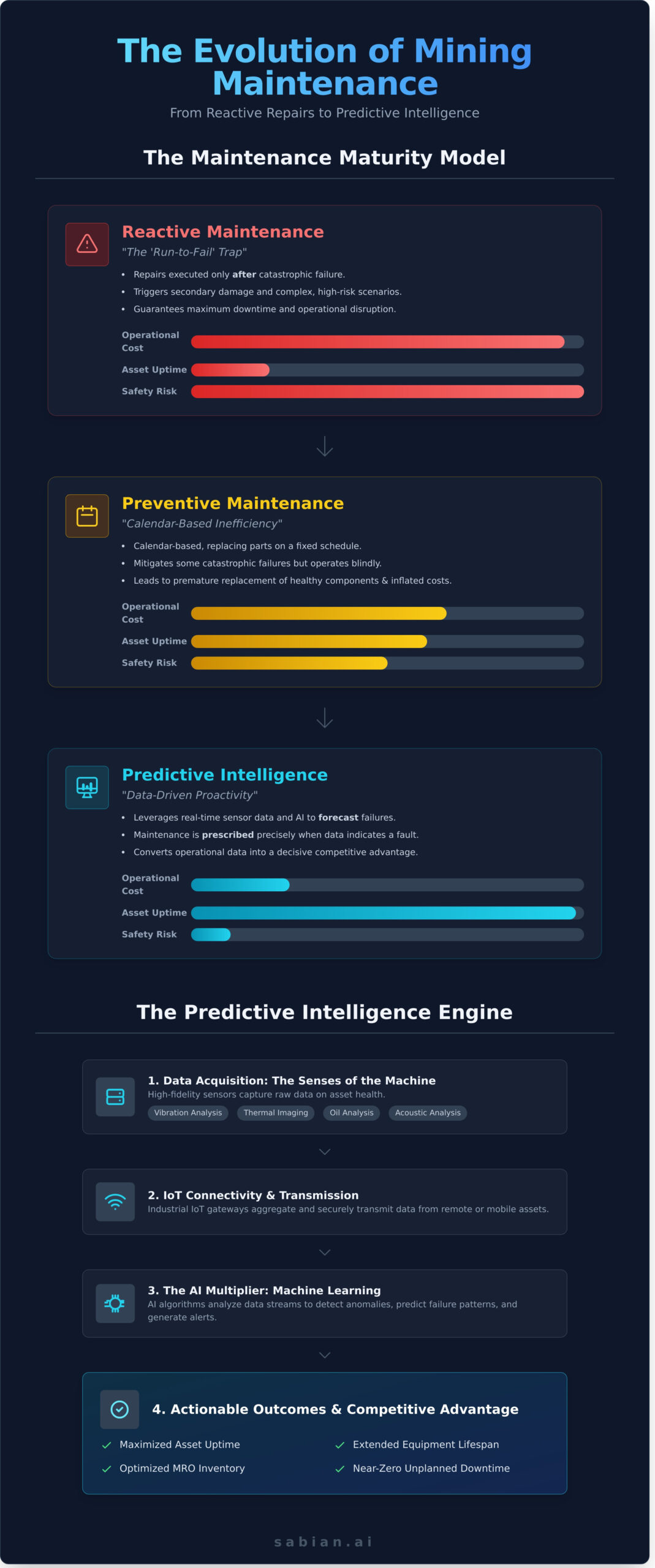
This progression can be understood through a clear maintenance maturity model, moving from costly chaos to data driven control.
Reactive Maintenance: The ‘Run-to-Fail’ Trap
Characterized by emergency repairs executed only after a component has failed, this primitive strategy is the costliest approach. A catastrophic gearbox failure on a primary conveyor doesn’t just halt production; it triggers a cascade of secondary damage to motors and belts, creating complex, high-risk repair scenarios. This model guarantees maximum downtime and operational disruption.
Preventive Maintenance: A Step Forward, But Inefficient
Preventive maintenance introduces a calendar-based discipline, replacing parts on a fixed schedule, regardless of their actual condition. While this approach mitigates some catastrophic failures, it operates blindly. It frequently leads to the premature replacement of healthy components, inflating labor and MRO (Maintenance, Repair, and Operations) inventory costs without a clear return on investment.
Predictive Maintenance: Data-Driven Proactivity
The apex of this evolution is Predictive Intelligence. By leveraging real-time data from sensors and AI algorithms, predictive maintenance techniques forecast equipment failures with precision before they occur. Maintenance is no longer scheduled; it is prescribed precisely when data indicates a developing fault. The strategic implementation of predictive maintenance mining transforms operations by achieving:
-
Maximized Asset Uptime: Interventions are planned, minimizing disruption to production schedules.
-
Extended Equipment Life: Assets are maintained based on actual need, not arbitrary timelines.
-
Optimized MRO Inventory: Parts are ordered just-in-time, reducing carrying costs and waste.
This data-driven proactivity is the definitive standard for modern
**predictive maintenance mining
**, converting operational data into a decisive competitive advantage.
Core Components of a Mining Predictive Maintenance Program
A successful predictive maintenance program is not a singular software but a robust technological ecosystem. In the extreme conditions of a mine-from corrosive dust to severe vibrations each component must be purpose-built for resilience and reliability. The architecture is designed for a precise flow of information: from high-fidelity sensors capturing raw data, through a network that transmits it, to a central platform where AI generates actionable intelligence. This is the foundational framework for transforming operational data into predictive power.
Data Acquisition: The Eyes and Ears of Your Equipment
High-quality data is the bedrock of any effective predictive maintenance mining strategy. It requires deploying specialized techniques to monitor the unique failure modes of critical assets. Key methods include:
-
Vibration Analysis: Essential for monitoring the health of rotating equipment like SAG mills, crushers, and conveyor motors by detecting imbalances, misalignments, and bearing wear.
-
Thermal Imaging: Identifies overheating in electrical components, motors, and hydraulic systems, providing early warnings of imminent failures or fire hazards.
-
Oil Analysis: Acts as a blood test for engines and gearboxes, revealing internal wear, contamination, and fluid degradation long before catastrophic failure occurs.
-
Acoustic Analysis: Uses ultrasonic sensors to detect high-frequency sound waves indicative of compressed air leaks, electrical arcing, or developing structural stress in fixed assets.
Sensor Technology and IoT Connectivity
Data acquisition is powered by industrial-grade sensors engineered to survive harsh mining environments. These are not off-the-shelf components; they are hardened accelerometers, thermal cameras, and pressure sensors designed for continuous operation. IoT gateways are critical for aggregating this data from remote or mobile assets-like haul trucks and excavators-and transmitting it securely. Overcoming connectivity gaps in vast open-pit sites or deep underground operations often requires a hybrid approach, utilizing mesh networks, Wi-Fi, and Low-Power Wide-Area Networks (LPWAN) to ensure a constant data stream.
The Centralized Data Platform
Siloed data is the primary obstacle to predictive intelligence. A centralized data platform is non-negotiable, unifying disparate data streams into a single source of truth. This system integrates real-time sensor feeds with contextual data from your Computerized Maintenance Management System (CMMS), such as asset history and past work orders. This holistic dataset is the fuel for sophisticated machine learning models, a concept further detailed in academic research on AI-Driven Predictive Maintenance in Mining. The choice between cloud and on-premise solutions depends on site connectivity, data security protocols, and the need for scalable computational power to run complex AI algorithms.
Implementing Predictive Maintenance: A Phased Roadmap for Mine Operators
Transitioning from reactive to predictive operations is a strategic imperative, not a single technological leap. A successful predictive maintenance mining program is built on a methodical, phased framework. This roadmap deconstructs the implementation journey into manageable stages, ensuring alignment with core business objectives like production uptime and asset longevity from day one. The key is to start with a focused, high-impact pilot project to prove value before scaling.
Phase 1: Asset Criticality Assessment & Pilot Project
The initial phase is foundational, focusing capital and effort where it generates maximum impact. By systematically ranking assets based on their operational criticality-considering production loss, safety implications, and repair costs-you can isolate high value targets. A focused pilot on one or two of these assets, such as a primary gyratory crusher or a critical haul truck, de-risks the initiative and provides a tangible proof of concept.
-
Identify Critical Assets: Conduct a Failure Mode and Effects Analysis (FMEA) to pinpoint machinery whose failure causes the most significant disruption.
-
Select Pilot Candidates: Choose 2-3 of these critical assets for the initial program.
-
Define Success Metrics: Establish clear, measurable goals, such as predicting one specific type of major failure or reducing unplanned downtime on the pilot asset by 15%.
Phase 2: Technology Deployment and Data Collection
With pilot assets selected, the focus shifts to deploying the necessary technological infrastructure. This involves instrumenting the machinery with high fidelity sensors vibration, thermal, acoustic-to capture the requisite data streams. Establishing robust protocols for data acquisition, transmission, and secure storage is critical. This stage is not merely about collecting data; it’s about building the high quality historical dataset that will serve as the performance baseline for future AI models.
Phase 3: Analysis, Model Building, and Scaling
This is where raw data transforms into predictive intelligence. By analyzing the baseline data, machine learning algorithms can define the parameters of normal operation and detect subtle anomalies that precede component failure. The development of these initial models is a core component of effective AI-driven predictive maintenance in mining, allowing systems to learn the unique failure signatures of your equipment. A successful pilot, validated by predefined metrics, becomes the undeniable business case for scaling the program across the entire operation.
The AI Multiplier: Elevating PdM with Machine Learning
Traditional condition monitoring is reactive, triggering alerts when a predefined limit is breached. Artificial intelligence transforms this paradigm, elevating predictive maintenance from a system of simple alarms to one of deep operational foresight. This is the fundamental shift at the core of modern, high value predictive maintenance mining. AI-powered systems analyze complex, multi dimensional data streams to identify subtle failure patterns that are entirely invisible to human analysis, providing weeks or even months of advance warning.
Beyond Thresholds: Anomaly Detection with Machine Learning
Legacy systems operate on a simple principle: if a single metric like temperature or vibration crosses a static threshold, an alarm sounds. AI models operate on a vastly more sophisticated level. They ingest and correlate hundreds of real-time variables-from acoustic signatures and oil pressure to motor amperage and load factors. This allows the system to detect subtle, anomalous relationships that signal the earliest stages of component degradation. For example, an AI can identify a future bearing fault weeks before a standard vibration alarm by recognizing a unique pattern across three seemingly unrelated sensors.
From Prediction to Prescription: Root Cause Analysis
The most advanced AI platforms move beyond simply predicting what will fail to prescribing why it will fail. This is the critical step from prediction to prescription. Instead of leaving maintenance teams to diagnose a generic alert, the system provides high-probability root causes, drastically reducing diagnostic time and eliminating guesswork. An alert evolves from a vague warning to a specific directive: "Failure risk elevated in haul truck #7. Probable cause: lubrication degradation in bearing assembly #3." This level of insight empowers teams to act decisively.
Optimizing Asset Lifecycle and Strategy
The strategic impact of AI-driven insights extends far beyond immediate repairs. By accurately forecasting equipment health, operators can transition from reactive fixes to a truly optimized asset management strategy. This is where the full value of predictive maintenance mining is realized.
-
Refined Maintenance Schedules: Move from rigid, time-based preventive maintenance to dynamic, condition-based interventions, servicing assets precisely when needed.
-
Remaining Useful Life (RUL) Forecasting: Gain accurate, data-driven predictions on the RUL of critical components like SAG mill liners or gearbox assemblies.
-
Informed Capital Planning: Use reliable failure forecasts to make strategic decisions about major asset replacements, optimizing CapEx and ensuring fleet availability.
The true power of this technology lies in its ability to convert vast streams of raw sensor data into actionable, strategic intelligence. See how AI transforms raw data into predictive intelligence.
Predictive Maintenance in Action: Real-World Mining Applications
Theoretical frameworks for AI-driven maintenance become operational realities when applied to high-value mining assets. The transition from reactive repairs to predictive intervention is not abstract; it is a quantifiable strategy proven across mobile fleets and fixed plant infrastructure. Effective predictive maintenance mining programs target specific, high cost failure modes to deliver maximum operational impact.
Application: Haul Truck Fleet
A mine’s mobile fleet represents a significant capital investment and a primary vector for production loss. AI models analyze telematic data streams to forecast component failure with precision. Key applications include:
-
Powertrain Integrity: Predicting degradation in engines, transmissions, and final drives by correlating subtle changes in temperature, pressure, and vibration with known failure signatures.
-
Tire Management: Monitoring tire pressure and temperature in real-time to preempt catastrophic blowouts, which can halt production and pose significant safety risks.
-
Fuel Optimization: Analyzing operator behavior, haul routes, and engine load to identify opportunities for reducing fuel consumption without impacting productivity.
Application: Fixed Plant (Crushers, SAG Mills, Conveyors)
For stationary assets, predictive intelligence focuses on forecasting the wear of critical components and preventing sudden, catastrophic breakdowns. AI algorithms continuously monitor sensor data to detect anomalies invisible to human operators, such as:
-
SAG Mill Liner Wear: Forecasting the wear rate of mill liners to schedule replacements just in time, maximizing lifespan while avoiding costly unplanned shutdowns.
-
Crusher Bearing Failure: Detecting nascent bearing faults in primary crushers through advanced vibration and acoustic analysis, allowing for planned component replacement.
-
Conveyor System Failure: Monitoring belt tension, alignment, and surface wear to prevent belt rips that can halt the entire processing circuit for days.
Calculating the Return on Investment (ROI)
The financial justification for a predictive maintenance program is direct and compelling. The ROI is calculated by quantifying the value created against the program’s cost:
(Cost of Downtime Avoided + Maintenance Savings) / PdM Program Cost = ROI
Consider a primary crusher where an unexpected bearing failure results in 24 hours of downtime, costing $400,000 in lost production and $75,000 in emergency repair. An AI powered system costing $50,000 annually predicts the failure weeks in advance, allowing for a scheduled, low-cost repair. The ROI for this single event is over 9x. Across an entire operation, returns frequently exceed 10x the initial investment. Harnessing this level of predictive intelligence is the core mission of platforms like AI for Critical Minerals.
From Prediction to Production: The New Era of Mining Intelligence
The transition from reactive repairs to data driven foresight represents a fundamental evolution in operational strategy. As we’ve explored, a successful program is built on robust data collection, strategic AI integration, and a phased implementation roadmap. Embracing predictive maintenance mining is no longer a future concept but a present-day imperative for maximizing asset uptime, enhancing safety, and securing a competitive edge in a demanding global market.
The next step is to leverage technology designed for this specific, high-stakes environment. Sabian.ai delivers operational foresight from geology to recovery with purpose-built AI for the critical minerals industry. Trusted by leaders in rare earth production, we empower operations to move beyond maintenance schedules and into the realm of true predictive intelligence. Discover the power of predictive intelligence for mining operations.
The future of your operation isn’t written in stone it’s predicted in data. The power to anticipate equipment needs and prevent costly downtime is within your grasp. It’s time to harness it.
Frequently Asked Questions About Predictive Maintenance in Mining
What is the difference between predictive maintenance and condition monitoring?
Condition monitoring provides a real-time snapshot of asset health. Predictive maintenance elevates this by deploying AI to analyze historical and real time data streams. It doesn’t just report current conditions; it forecasts specific failure modes and calculates the remaining useful life of critical components. This transforms maintenance from a reactive process into an intelligence-driven, proactive strategy, optimizing asset availability and performance.
How much does it cost to implement a predictive maintenance program in a mine?
Implementation costs are contingent on the scale of deployment, existing sensor infrastructure, and data maturity. A pilot program for a single critical asset, like a haul truck or primary crusher, offers a defined entry point. While full scale deployment is a significant capital investment, ROI is calculated through direct reductions in catastrophic failures, optimized maintenance scheduling, and quantifiable increases in production throughput. The investment is benchmarked against the high cost of unplanned downtime.
What skills does my maintenance team need to support a PdM program?
Your team’s core mechanical and electrical expertise remains fundamental. The evolution is in enhancing data literacy. Technicians must be trained to trust and act on AI generated alerts and work orders from the PdM platform. The focus shifts from traditional diagnostics to executing data driven maintenance strategies. This augments existing skill sets with a new layer of predictive intelligence, empowering your team to prevent failures before they occur.
Can predictive maintenance work in our harsh and remote mining environment?
Absolutely. Modern systems are engineered for the extreme conditions of mining. Industrial grade IoT sensors withstand vibration, dust, and temperature fluctuations, while edge computing processes data on site, minimizing reliance on constant connectivity. This ensures the intelligence layer functions reliably even in the most challenging operational theaters. Robust design makes effective predictive maintenance mining a reality, regardless of location.
How long does it take to see a return on investment from predictive maintenance?
The timeline for ROI is directly correlated to the criticality of the monitored assets. For high impact equipment like SAG mills or shovels, preventing a single unplanned failure can generate a return within months. A comprehensive, site wide implementation typically demonstrates significant ROI within 12 to 24 months, measured through quantifiable increases in equipment uptime, reduced maintenance costs, and improved production efficiency.
Do we need a data scientist to run a predictive maintenance system?
No. Advanced platforms are designed to translate complex data science into actionable insights for maintenance planners and reliability engineers. The core AI and machine learning models are developed and managed by the solution provider. Your team interacts with a clear interface that delivers precise failure alerts and maintenance recommendations, effectively engineering the need for an in house data scientist out of the operational workflow.