
Hi, this is a comment. To get started with moderating, editing, and deleting comments, please visit the Comments screen in…
ESG in
Mining: The 2026 Strategic Imperative for a Sustainable Future
The term ESG has shifted from a boardroom buzzword
to a non-negotiable operational reality. For mining executives,
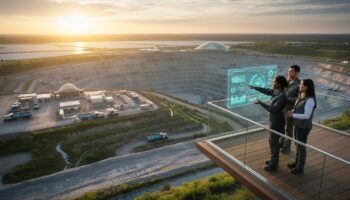
The term ESG has shifted from a boardroom buzzword to a non-negotiable operational reality. For mining executives, navigating the mounting pressure from investors, regulators, and supply chain partners is no longer optional it’s a critical strategic challenge. Distinguishing credible action from corporate greenwashing has become paramount. The future viability of the sector depends on a clear, data driven approach to ESG in mining, transforming it from a perceived liability into a strategic imperative for 2026 and beyond.
This definitive guide moves beyond abstraction. We dissect the Environmental, Social, and Governance pillars within the unique context of mining operations, revealing the material risks and strategic opportunities at every stage. You will gain a clear framework for making a compelling business case, separating genuine impact from superficial claims, and leveraging advanced technology to drive both sustainability and operational excellence.
Deconstructing ESG: What It Truly Means for the Mining Sector
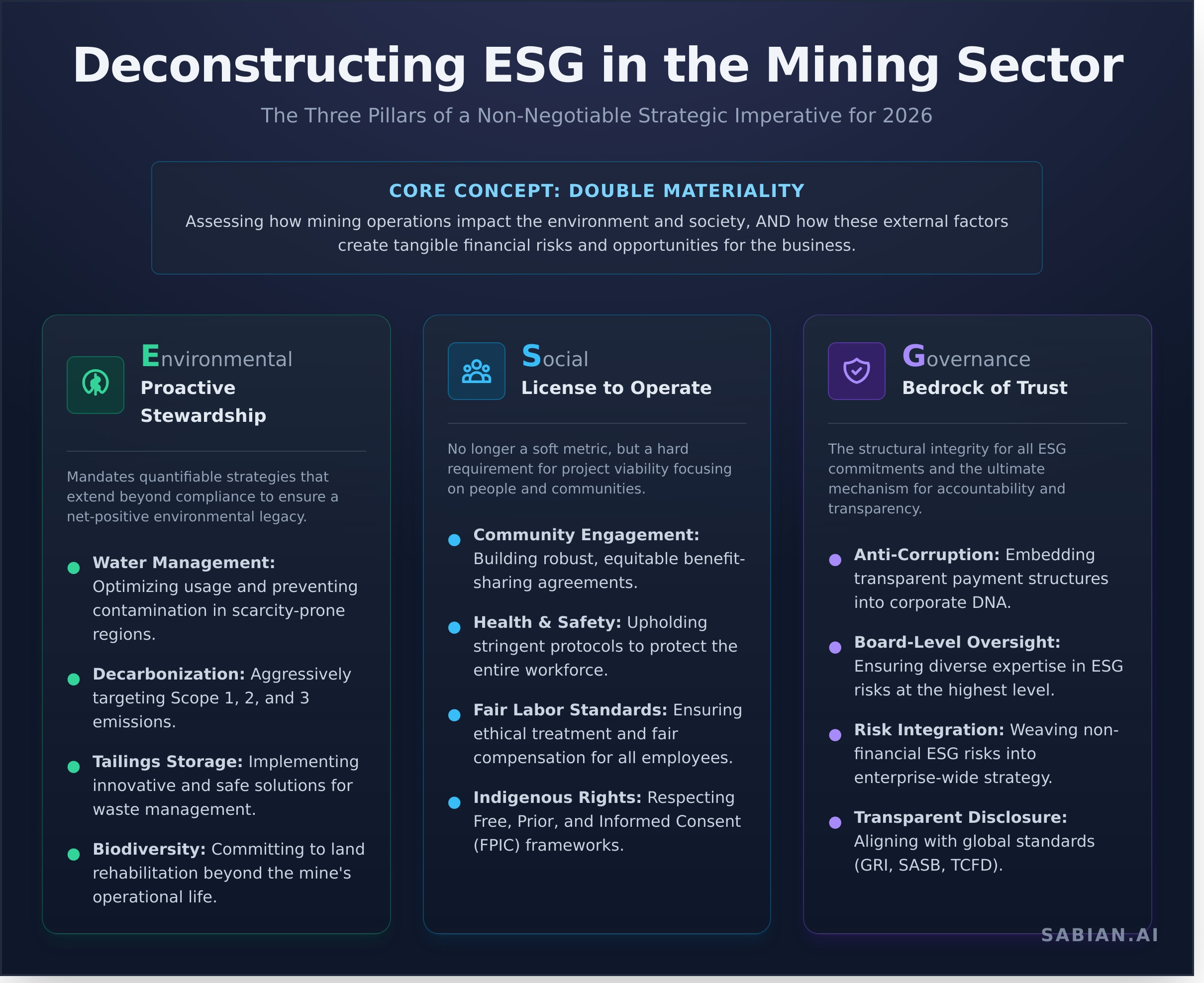
The term Environmental, Social, and Governance (ESG) has transcended corporate jargon to become a critical operational framework. For the modern resource sector, effective esg in mining is no longer a peripheral ‘nice-to-have’ but a core driver of long term value, resilience, and investor confidence. It represents a paradigm shift, demanding a sophisticated approach to risk and opportunity. This is encapsulated in the concept of ‘double materiality’ assessing not only how an operation impacts the environment and society, but also how these external factors create tangible financial risks and opportunities for the enterprise itself.
Understanding ESG requires moving beyond the acronym to its three distinct, yet interconnected, pillars of performance.
The ‘E’ Environmental Stewardship: Beyond Compliance
This pillar mandates a move from passive compliance to proactive stewardship. It requires quantifiable strategies for water management in scarcity-prone regions, aggressive decarbonization targeting Scope 1-3 emissions, and innovative solutions for the critical challenge of safe tailings storage. Furthermore, it demands a commitment to land rehabilitation and biodiversity protection that extends far beyond the life of the mine, ensuring a net-positive environmental legacy.
The ‘S’ Social License to Operate: People and Communities
The social license to operate is no longer a soft metric; it is a hard requirement for project viability and continuity. This dimension focuses on the human element of mining, encompassing robust community engagement, equitable benefit-sharing agreements, and stringent health and safety protocols to protect the workforce. Critically, it includes upholding fair labor standards and respecting the rights of Indigenous Peoples through frameworks like Free, Prior, and Informed Consent (FPIC).
The ‘G’ – Governance: The Bedrock of Trust and Transparency
Effective governance provides the structural integrity for all ESG commitments and is the ultimate mechanism for accountability. This involves embedding anti-corruption policies and transparent payment structures into corporate DNA. It demands board-level oversight with diverse expertise in ESG risks and requires the integration of these non-financial risks into enterprise-wide strategy. Transparent disclosure, aligned with global standards like GRI, SASB, and TCFD, is the definitive proof of commitment.
The Driving Forces: Why ESG is a Non-Negotiable 2026 Imperative
The operational landscape for mineral extraction has fundamentally and irrevocably shifted. Inaction on Environmental, Social, and Governance (ESG) criteria is no longer a viable strategy; it is a direct threat to corporate existence. The imperative for robust esg in mining is driven by a powerful convergence of financial, regulatory, and market pressures. ESG has transformed from a corporate social responsibility metric into a primary indicator of operational excellence and a prerequisite for market access and capital.
Investor Pressure and The New Cost of Capital
Global capital flows are now governed by ESG algorithms. Major institutional investors and asset managers integrate ESG scores into every phase of their decision-making, treating poor performance as a material risk. This has created a clear bifurcation in the market: companies with high ESG ratings are securing a lower cost of capital, while laggards face higher premiums and restricted access to ESG-linked financial products. Shareholder activism has also intensified, demanding transparent, verifiable ESG performance as a core component of corporate strategy.
Regulatory Scrutiny and Evolving Global Standards
The era of voluntary reporting is over. Mandatory frameworks like the Task Force on Climate-related Financial Disclosures (TCFD) and the EU Taxonomy are creating a new baseline for compliance, defining what qualifies as a ‘sustainable’ mining activity. This extends beyond emissions to the social license to operate, with guidance from bodies like the OECD on ESG in mining regions setting new benchmarks for community well-being. Legal liability for environmental and social harm is escalating, with future regulations poised to enforce stringent supply chain due diligence.
The Critical Minerals Paradox: Fueling the Green Transition Sustainably
The global energy transition is impossible without a massive increase in the supply of critical minerals like lithium, cobalt, and rare earth elements. This creates a profound paradox: the very minerals needed for clean technologies must be extracted through verifiably sustainable means. In this high stakes market, strong ESG credentials are a decisive competitive advantage, unlocking premium offtake agreements and partnerships. The reputational and financial risk of producing ‘dirty’ minerals for a ‘clean’ economy is absolute.
The Technology Catalyst: How AI is Solving Mining’s Toughest ESG Challenges
Traditional methods for managing environmental, social, and governance factors are no longer sufficient. The reactive, report-based approach of the past cannot meet the dynamic demands of investors, regulators, and communities in 2026. The future of esg in mining is not about documenting past events, but about predicting and preventing future risks. This paradigm shift is being driven by data and artificial intelligence, which transform ESG from a compliance exercise into a core operational advantage. By leveraging predictive intelligence, mining operations can move beyond legacy systems and adopt the forward-looking strategies required to achieve modern ESG best practices in mining.
Environmental Mitigation with Predictive AI
Artificial intelligence provides the foresight needed to proactively manage and mitigate environmental impact. Instead of reacting to incidents, operators can anticipate them. This capability is critical for decarbonization and sustainable resource management.
-
Water Management: AI driven systems analyze real-time data to optimize water usage, maximize recycling rates, and predict potential shortages or contamination events.
-
Predictive Maintenance: AI models monitor equipment health to forecast failures, preventing catastrophic spills and minimizing operational downtime.
-
Energy Optimization: Machine learning algorithms model and optimize energy consumption across the entire value chain, reducing carbon footprints and operational costs.
See how Predictive Intelligence transforms operational data into foresight.
Enhancing Social Performance Through Data
The "S" in ESG social performance is often the most complex to quantify and manage. AI and data analytics provide the tools to build trust and ensure safety with unprecedented accuracy.
-
Community Engagement: Natural language processing (NLP) can analyze public data to monitor community sentiment, allowing for proactive engagement and conflict resolution.
-
Workplace Safety: AI-powered computer vision and sensor data analysis can identify unsafe conditions and predict potential accidents before they occur.
-
Ethical Supply Chains: AI helps map and monitor complex supply chains, verifying ethical labor practices and ensuring transparency from mine to market.
AI for Resource Efficiency and a Circular Economy
The most profound impact of AI on esg in mining is its ability to maximize resource recovery while minimizing waste. This directly links operational efficiency to environmental stewardship, creating a foundation for a circular economy.
-
Optimized Geometallurgy: AI enhances geometallurgical models to precisely target high-value ores, maximizing recovery and reducing the volume of waste rock.
-
Tailings Reprocessing: Advanced AI, like a RECLAIM ENGINE, can assess the economic and environmental viability of reprocessing tailings to extract residual critical minerals.
-
Process Stabilization: Predictive models stabilize complex chemical processes like solvent extraction, significantly cutting reagent consumption and associated environmental risks.
Building a Future-Proof ESG Strategy: A Framework for Mining Leaders
An effective ESG strategy is not a peripheral compliance function; it is an integrated component of corporate DNA that drives long-term value. For mining leaders, moving beyond risk mitigation to active value creation requires a disciplined, top down commitment. This framework outlines the critical steps to embed ESG into the core of your organization, transforming it from a reporting exercise into a strategic advantage. A culture of accountability, championed by leadership, is the foundation for success.
Step 1: Conduct a Materiality Assessment
The first imperative is to define what truly matters. A materiality assessment identifies the most significant ESG issues for your specific operations and stakeholders from investors and regulators to employees and local communities. This process ensures that resources are deployed with maximum impact, focusing on challenges like water stewardship, biodiversity, and community relations. This foundational analysis is crucial for building a relevant and powerful strategy for esg in mining.
Step 2: Integrate ESG into Core Operations and Capex
To be effective, ESG must be hardwired into every operational decision. This means moving beyond a separate sustainability department and embedding ESG criteria directly into capital expenditure (CAPEX) planning and asset management. Leading companies are setting clear, science-based targets for emissions and water use, then directly linking executive compensation to the achievement of these KPIs. This creates unambiguous accountability and aligns financial incentives with sustainability performance.
Step 3: Leverage Technology for Measurement and Reporting
In a dynamic world, annual, static ESG reports are obsolete. Stakeholders demand real-time transparency and verifiable data. The future of ESG management lies in leveraging advanced technology to collect, analyze, and report on performance continuously. Digital platforms and AI powered dashboards provide the intelligence needed to monitor operations, predict risks, and communicate progress with authority. For industry leaders, Sabian’s platform provides the predictive intelligence needed for modern ESG management, turning complex data into strategic foresight.
From Imperative to Advantage: The Future of ESG in Mining
The path to 2026 is clear: Environmental, Social, and Governance principles have evolved from a peripheral concern into the central strategic imperative for the mining sector. The key takeaway is twofold: ESG is non-negotiable for securing investment and social license, and advanced technology is the catalyst for turning this obligation into a competitive edge. The successful implementation of esg in mining depends on leveraging intelligent systems to transform vast operational data into predictive, actionable foresight. This is no longer about reporting on the past; it is about programming a more sustainable and profitable future.
Pioneering this new frontier requires a new class of intelligence. Sabian.ai delivers this with the world’s first AI platform for rare earths, engineered to provide unparalleled intelligence for the critical minerals supply chain. We empower leaders to translate complex plant data into decisive operational advantages, future-proofing their operations against a rapidly changing landscape. The opportunity to lead is now.
Discover how Predictive Intelligence is shaping the future of sustainable mining.
Frequently Asked Questions
What are the most influential ESG rating agencies and frameworks for the mining industry?
Major mining operators are benchmarked against specific, rigorous standards. Influential rating agencies include MSCI and Sustainalytics, which provide quantitative risk assessments for investors. Critical frameworks dictating disclosure and performance are the IFRS S2 (formerly SASB) standards for Metals & Mining, the Global Reporting Initiative (GRI), and the comprehensive Initiative for Responsible Mining Assurance (IRMA). These frameworks provide the operational blueprint for demonstrating ESG commitment and mitigating risk in capital markets.
How does a mining company’s ESG performance directly impact its stock price and valuation?
Superior ESG performance directly correlates to enhanced market valuation and a lower cost of capital. Investors increasingly apply an ESG risk premium to companies with poor performance, depressing stock prices. Conversely, high ESG ratings attract capital from institutional investors and ESG-mandated funds, signaling operational resilience and long term viability. This de-risks the asset, making it a more attractive investment and positively impacting share price through lower perceived volatility and greater access to financing.
What is a ‘social license to operate’ and why is it so critical in mining?
A social license to operate (SLO) is the ongoing acceptance of a company’s mining project by its local community and other stakeholders. It is an intangible, unwritten contract essential for operational continuity. Without it, companies face protests, permitting delays, and legal challenges, leading to significant financial losses and project failure. In an industry with a multi decade project lifecycle, securing and maintaining this social contract is a non-negotiable component of risk management and long-term asset value.
Can mining, an extractive industry, ever be considered truly ‘sustainable’?
While "sustainability" is a complex term for an extractive industry, the paradigm is shifting toward responsible resource stewardship. The objective is to minimize environmental impact, maximize social benefit, and contribute net-positive value. Through advanced reclamation, circular economy principles, and providing the critical minerals essential for the global energy transition, the sector’s role becomes foundational to a sustainable future. Strong performance in ESG in mining is the metric for this responsible approach.
How are smaller and mid-tier mining companies managing the high cost of ESG implementation?
Smaller and mid-tier operators are leveraging technology and strategic focus to manage ESG implementation costs. Instead of broad, resource intensive programs, they prioritize material risks specific to their operations, such as water management or community relations. The adoption of predictive analytics and AI driven monitoring platforms allows for more efficient resource allocation, automating compliance reporting and proactively identifying risks. This targeted, technology-first approach maximizes impact while controlling capital expenditure.
What is the role of tailings dam management in a company’s overall ESG risk profile?
Tailings dam management represents one of the most significant material risks in a mining company’s ESG profile. A catastrophic failure has devastating environmental and social consequences, leading to immense financial liability and reputational ruin, as seen in the Brumadinho disaster. Adherence to the Global Industry Standard on Tailings Management (GISTM) is now a baseline expectation from investors. Proactive monitoring and governance of these facilities are critical indicators of a company’s fundamental risk management capabilities.