
Hi, this is a comment. To get started with moderating, editing, and deleting comments, please visit the Comments screen in…
Analyzing Today’s
Copper Prices and Future Trends
A real time price chart offers a single data
point, but for strategic decision makers, it reveals

A real time price chart offers a single data point, but for strategic decision makers, it reveals nothing of the complex forces at play. Volatility in copper prices isn’t random; it’s the output of a complex global equation involving geopolitical shifts, supply chain disruptions, and the accelerating energy transition. Making critical purchasing or investment decisions based on lagging indicators is a significant, and unnecessary, business risk.
This analysis moves beyond the surface level data. We will deconstruct the fundamental drivers of supply and demand, from mine-level production intelligence to critical macroeconomic indicators. You will gain a clear perspective on the key trends that will impact future copper values and the health of the global market.
Crucially, we explore how predictive intelligence is revolutionizing this landscape. Discover how AI-driven forecasting provides the strategic foresight needed to navigate market volatility, transforming raw data into a decisive competitive advantage.
What is ‘Dr. Copper’ and Why Does Its Price Matter?
In global economics, few commodities command the predictive authority of copper. It is often referred to as “Dr. Copper” for its purported Ph.D. in economics a nickname earned from its uncanny ability to forecast turning points in the global economy. Because of its widespread use in foundational sectors like manufacturing, construction, and electronics, its price provides a real-time pulse on industrial health. Consequently, a diverse range of stakeholders, from mining conglomerates and industrial manufacturers to governments and financial institutions, monitor copper prices with extreme precision to inform strategic decisions.
Key Industrial Applications Driving Demand
Copper’s role as an economic bellwether is rooted in its indispensable industrial applications. Its superior conductivity and durability make it a cornerstone material across multiple domains:
-
Construction & Infrastructure: Essential for electrical wiring, plumbing systems, and telecommunications networks that form the backbone of modern cities.
-
Electronics & Manufacturing: A fundamental component in circuit boards, semiconductors, and electric motors, powering everything from consumer devices to heavy machinery.
-
The Green Energy Transition: Critical for electrification and renewable energy systems. Electric vehicles (EVs), charging stations, wind turbines, and solar panels all require significantly more copper than their conventional counterparts.
Copper as a Global Economic Barometer
The correlation between copper demand and global economic activity is exceptionally strong. A rise in demand, and subsequently price, often signals an expansion in industrial output and is closely tied to metrics like the global Manufacturing Purchasing Managers’ Index (PMI). Conversely, a significant downturn in copper prices can act as an early warning for an impending economic slowdown or recession, as it reflects reduced orders for finished goods and large-scale construction projects.
Major Markets and Exchanges (LME, COMEX)
Global price discovery for copper is centralized in two primary exchanges. The London Metal Exchange (LME) is the world’s premier center for industrial metals trading, setting the global benchmark prices used in physical contracts. In North America, the COMEX (Commodity Exchange), operated by the CME Group, is the leading market for copper futures and options. These exchanges provide critical liquidity, transparency, and risk management tools for the entire copper value chain.
Deconstructing the Core Drivers: Copper Supply and Demand
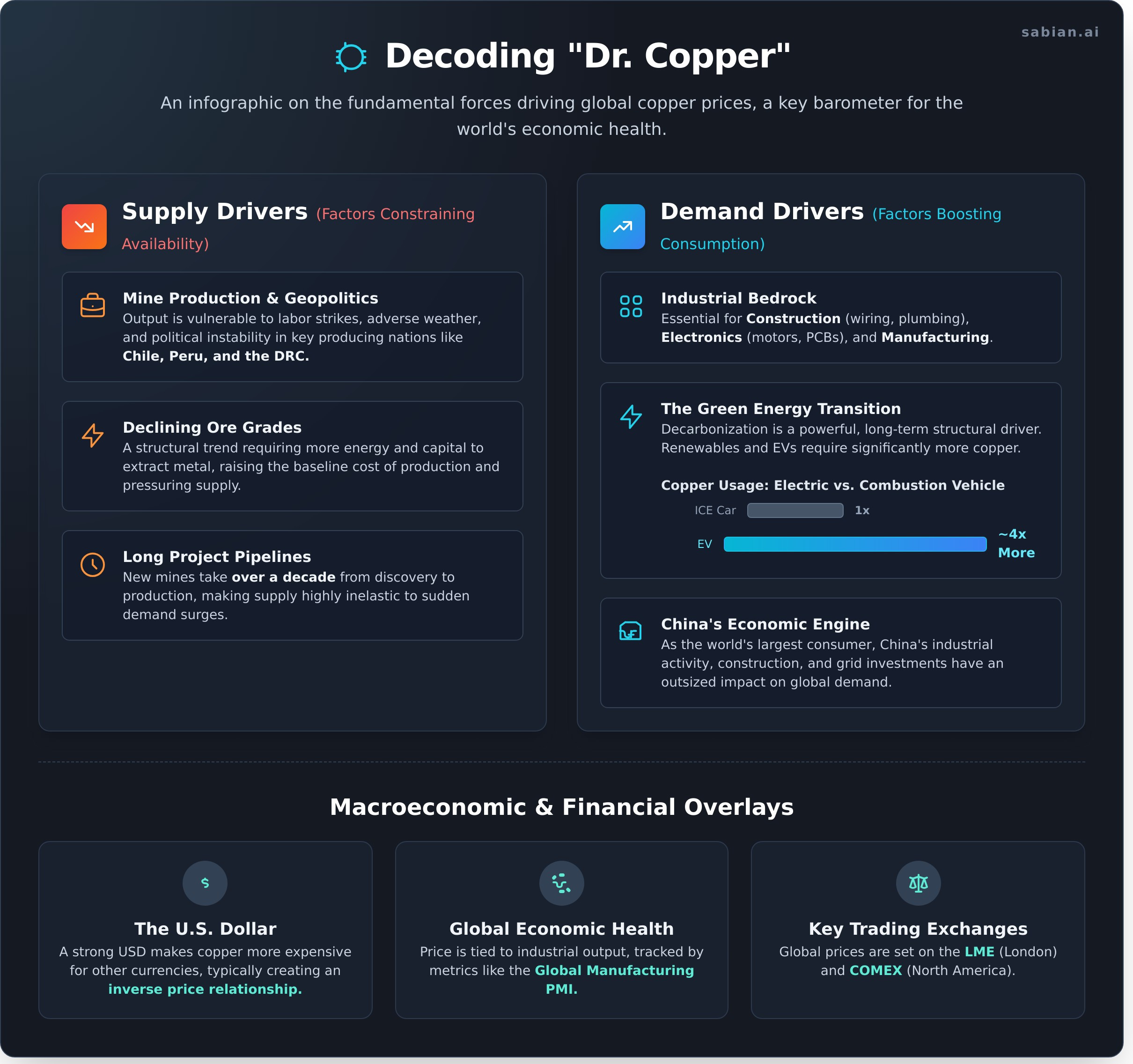
At its core, the global copper market operates on the fundamental economic principle of supply and demand. The trajectory of copper prices is a direct reflection of the balance or imbalance between these two forces. A market deficit, where demand outstrips available supply, exerts upward pressure on prices. Conversely, a surplus, where supply exceeds demand, leads to price declines. A comprehensive analysis of global copper supply and demand data reveals a complex interplay between a concentrated group of producers, led by Chile, Peru, and the DRC, and a global consumption base dominated by industrial powerhouses like China, Europe, and North America.
Supply-Side Factors
The supply equation for copper is characterized by significant lead times and inherent operational risks. Key variables that introduce volatility include:
-
Mine Production: Output from primary producing regions is susceptible to disruptions from labor strikes, adverse weather events, and technical challenges. Geopolitical instability in nations like Chile or Zambia can instantly throttle global supply chains.
-
Declining Ore Grades: A persistent structural challenge is the gradual decline in the quality of copper ore. Extracting metal from lower-grade deposits requires more energy and capital, effectively raising the baseline cost of production.
-
New Project Pipelines: Bringing a new large-scale copper mine from discovery to production can take over a decade. This long lead time makes the supply side highly inelastic in the short-to-medium term, unable to respond quickly to sudden demand surges.
Demand-Side Factors
Copper demand is a direct barometer of global economic health, driven by both traditional industry and future-facing technological shifts. The primary demand vectors are:
-
China’s Economic Activity: As the world’s largest consumer, China’s performance in sectors like real estate construction, industrial manufacturing, and state led power grid investment has an outsized impact on global demand.
-
The Green Energy Transition: Decarbonization is a powerful, long term structural driver. Copper is indispensable for electric vehicles (EVs), which use up to four times more copper than internal combustion engine cars, as well as for wind turbines, solar panels, and the vast charging infrastructure required to support them.
-
Scrap Copper Availability: Secondary production from recycled scrap plays a crucial role in supplementing primary mine supply. The flow of scrap material helps balance the market and can act as a buffer during periods of supply tightness.
Macroeconomic Forces Influencing Copper Prices
Copper is more than a physical asset; it is a critical barometer of global economic health, often called "Dr. Copper" for its predictive power on economic trends. As a globally traded commodity, its value is deeply intertwined with financial market dynamics, making the analysis of copper prices a complex synthesis of economic indicators. Understanding these macroeconomic drivers is fundamental to forecasting future market movements.
The U.S. Dollar’s Dominance
Because copper is priced globally in U.S. dollars, a powerful inverse relationship exists. When the USD strengthens against other currencies, it requires more of a local currency to purchase the same amount of copper. This effectively increases the cost for major consumers in Europe or Asia, which can dampen demand and exert downward pressure on the dollar-denominated price. While this correlation is robust, it can be superseded by acute supply deficits or surges in fundamental demand.
Interest Rates and Monetary Policy
Monetary policy, particularly from central banks like the U.S. Federal Reserve, sends critical signals to the market. The cost of capital directly influences investment in copper intensive industries.
-
Higher Interest Rates: Increased borrowing costs can slow economic activity. Capital intensive sectors that are major copper consumers such as construction, infrastructure development, and automotive manufacturing often scale back projects, reducing overall demand.
-
Lower Interest Rates: Conversely, lower rates stimulate borrowing and investment, encouraging expansion in these same sectors and typically boosting copper consumption and supporting higher prices.
Consequently, central bank announcements are closely monitored by commodity traders for indications of future economic trajectory.
Inflation and Energy Costs
The interplay between inflation and energy costs presents a dual impact on the copper market. Historically, investors have utilized hard assets like copper as a hedge against currency devaluation during high inflation periods. However, inflation also drives up operational costs. The mining, milling, and refining of copper are profoundly energy intensive, with processes like smelting and electrolysis consuming vast amounts of electricity and fuel. A sustained rise in oil and natural gas prices directly elevates production costs, which can constrain supply as less profitable operations are curtailed, ultimately putting upward pressure on the metal’s price.
Navigating these complex, interconnected variables requires sophisticated predictive intelligence. Platforms like Sabian.ai leverage AI to model these forces, offering a strategic advantage in forecasting commodity markets.
Forecasting Copper Prices: Future Outlook and the Role of AI
Accurately forecasting commodity movements is a formidable challenge, yet strategic decisions depend on it. While short-term fluctuations in copper prices are driven by a complex web of cyclical factors, a powerful long term structural narrative is emerging. The key to navigating this landscape is distinguishing between transient market noise and fundamental, technology-driven shifts.
Long-Term Outlook: The Electrification Super cycle
The global transition to a low carbon economy is fundamentally a transition to a high intensity metals economy, with copper at its core. Massive requirements for electric vehicles (EVs), renewable energy infrastructure, and grid modernization are creating a demand profile unseen in generations. Projections suggest that clean energy applications alone could add several million tonnes to annual copper demand by 2030, fueling concerns of a long-term structural supply deficit as new mine development fails to keep pace.
Navigating Short-Term Volatility
Despite the bullish long-term outlook, the path will be volatile. Traders and supply chain managers must monitor a constant stream of high-impact data points to manage risk. Key signals include:
-
Economic Indicators: Manufacturing PMI and industrial output data, particularly from China.
-
Inventory Levels: Real-time stock levels at major exchanges like the LME, SHFE, and COMEX.
-
Unforeseen Events: Geopolitical instability in producing nations, labor strikes, and sudden policy shifts from central banks.
Reacting to these market-moving events requires more than just data; it requires immediate and actionable intelligence.
Predictive Intelligence: How AI is Changing the Game
Traditional market analysis struggles to process the speed and scale of modern data. The next frontier is Predictive Intelligence, where AI and machine learning models analyze vast, unstructured datasets that are beyond human capability. These systems synthesize everything from satellite imagery of mine sites and real-time shipping data to linguistic analysis of policy documents and financial news.
Platforms engineered for critical minerals, like Sabian.ai, are designed to detect the faint signals that precede major market shifts. By identifying hidden correlations and emerging risks, this technology provides a decisive analytical advantage. In a market defined by both a long-term super cycle and acute short term risk, the ability to see what’s next is paramount.
Navigate market uncertainty with predictive intelligence.
Navigating the Future of Copper with Predictive Intelligence
The journey through the copper market reveals a landscape shaped by powerful, intersecting forces. From its status as ‘Dr. Copper’ a key economic indicator to the intricate balance of supply chain logistics and overarching macroeconomic trends, understanding this critical mineral is more complex than ever. Traditional analysis can no longer keep pace with the velocity of change. The future of forecasting copper prices and mitigating risk lies in a new paradigm: the fusion of deep domain expertise with the predictive power of artificial intelligence.
This is the frontier where Sabian operates. Our Predictive Intelligence Platform is the definitive tool for organizations seeking to master the critical minerals landscape. By harnessing proprietary AI for Critical Minerals, we empower you to de-risk your supply chain and convert market volatility into a strategic asset. Don’t just react to the market anticipate it. Leverage Sabian AI to transform copper market volatility into a strategic advantage.
The path forward is defined by data. Command your future in the critical minerals sector.
Frequently Asked Questions
Who are the world’s largest producers and consumers of copper?
The global copper market is geographically concentrated. Chile and Peru are the dominant producers, accounting for a significant share of primary mine output. Other major producers include China, the Democratic Republic of Congo, and the United States. On the consumption side, China is the undisputed leader, consuming over half of the world’s refined copper. This demand is driven by its massive manufacturing, construction, and infrastructure sectors, creating a fundamental imbalance between production and consumption centers.
How exactly is the daily price of copper determined?
The daily price of copper is established on global commodity exchanges, primarily the London Metal Exchange (LME), the COMEX division of the CME Group, and the Shanghai Futures Exchange (SHFE). Pricing is a dynamic function of supply and demand fundamentals, macroeconomic indicators such as GDP growth and industrial production, currency fluctuations, and real-time inventory levels in exchange-approved warehouses. Algorithmic trading and geopolitical events also introduce significant volatility into the price discovery mechanism.
Will copper be replaced by other materials like aluminum in the future?
While substitution by materials like aluminum is viable in specific applications such as power transmission lines, a wholesale replacement of copper is highly improbable. Copper possesses superior electrical and thermal conductivity, ductility, and corrosion resistance. These properties are mission-critical for high performance technologies, including electric vehicle motors, advanced electronics, and high efficiency energy systems. For these strategic applications, copper remains the benchmark material, with no technologically or economically viable substitute at scale.
What is the difference between the copper spot price and the futures price?
The copper spot price is the market price for the immediate physical delivery of the metal. It reflects the current, real-time balance of supply and demand. In contrast, the futures price is a predetermined price for the delivery of copper at a specified date in the future. The futures price incorporates market expectations for future supply disruptions, demand shifts, interest rates, and storage costs, serving as a critical tool for risk management and price forecasting.
How does scrap copper recycling affect global copper prices?
Scrap copper, or secondary production, is a vital component of global supply, satisfying approximately one-third of total demand. A high volume of available scrap can act as a buffer, supplementing primary mine output and moderating upward pressure on global copper prices during periods of high demand or supply disruption. Conversely, a reduction in scrap collection and processing rates can tighten the market, leading to increased price volatility and reliance on more carbon-intensive primary production.
Is copper considered a critical mineral?
Yes, copper is officially designated as a critical mineral by numerous governments, including the United States and the European Union. Its classification is based on its indispensable role in the global energy transition, national defense systems, and modern digital infrastructure. Copper is fundamental to electrification, renewable energy technologies like wind and solar, and electric vehicles. Its supply chain security is therefore considered a matter of strategic economic and national importance, directly influencing future copper prices.