
Hi, this is a comment. To get started with moderating, editing, and deleting comments, please visit the Comments screen in…
A Glossary
of Mining Terminology: From Adit to Zone of Accumulation
The global mining industry operates on a foundation of
highly specialized language. Reports, investment analyses, and technological

The global mining industry operates on a foundation of highly specialized language. Reports, investment analyses, and technological briefings are dense with terms that can obscure critical insights, creating a significant barrier for even astute professionals. When simple definitions lack operational context, the intricate relationships between processes-from exploration to reclamation-remain unclear. Understanding this essential mining terminology is not merely academic; it is fundamental to strategic decision-making in a sector undergoing rapid technological transformation.
This glossary is engineered to dismantle that barrier. We move beyond simplistic definitions to provide a foundational understanding of the complete mining lifecycle. Here, you will master the essential language of the industry, connecting traditional concepts to the advanced technologies shaping the future of resource extraction. Gain the strategic advantage of clarity, and confidently navigate any discussion, report, or analysis. This is your definitive resource for deciphering the language of mining, from adit to zone of accumulation.
Foundational Concepts: The Language of Geology and Ore Bodies
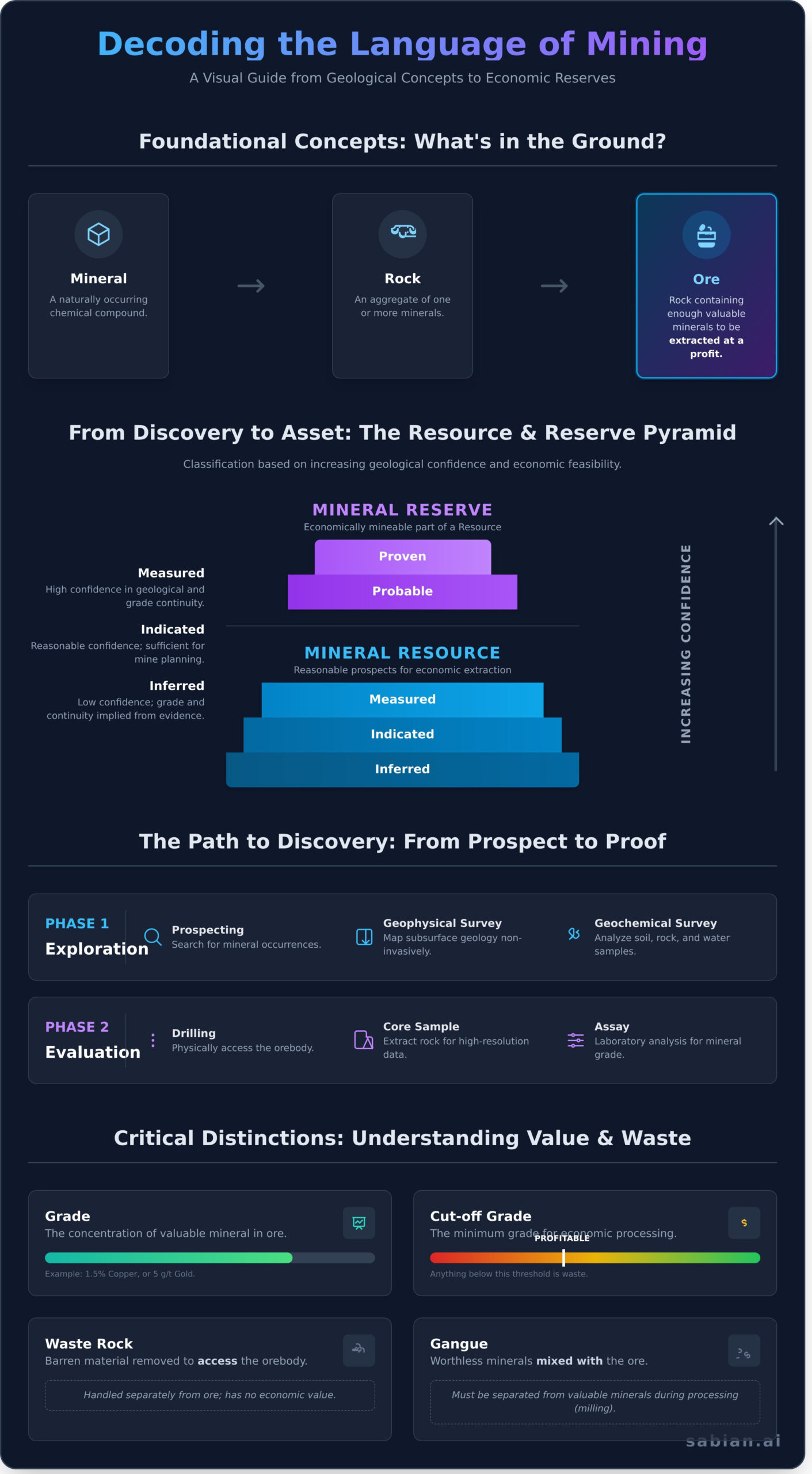
Precision in language is fundamental to the mining industry. The entire lifecycle of a mineral asset, from discovery to closure, is governed by a specific lexicon that quantifies value, risk, and operational feasibility. At its core, this language distinguishes between three foundational materials: a mineral, a naturally occurring chemical compound; a rock, an aggregate of minerals; and an ore, a rock containing minerals of sufficient value to be extracted at a profit. This distinction between simple geologic presence and economic viability is the critical first principle.
While this foundational mining terminology is universally applied, highly specialized sectors develop their own extensive vocabularies. For instance, the operational and safety terms used in coal extraction are vast, as detailed in resources like the Glossary of coal mining terminology. Mastering these core concepts, however, provides the framework for understanding any mining operation.
Defining the Resource
The transition from a geological curiosity to a viable asset is defined by a set of critical terms. These concepts quantify the material that will be handled and processed.
- Ore: Rock or sediment that contains a sufficient concentration of valuable minerals to warrant economic extraction. Its value must exceed the combined costs of mining, processing, and remediation.
- Orebody: A solid, continuous, and well-defined mass of ore. Its geometry, depth, and geological characteristics are key inputs for mine planning and design.
- Grade: The concentration of a valuable mineral within the ore. Grade is the primary determinant of an orebody’s value and is typically expressed as a percentage (e.g., copper, iron) or in grams per tonne (g/t) for precious metals like gold.
- Waste Rock: Barren or low-grade material that must be removed to access the orebody. It has no economic value and is managed separately from the ore.
Classifying the Deposit
Not all mineral deposits are equal. Geologists and engineers classify deposits based on geological confidence and economic feasibility. This classification is vital for investment decisions and regulatory compliance.
- Mineral Resource: A concentration of material in or on the Earth’s crust with reasonable prospects for eventual economic extraction. Resources are classified in order of increasing geological confidence as Inferred, Indicated, and Measured.
- Mineral Reserve: The economically mineable part of a Measured and/or Indicated Mineral Resource. A Reserve includes diluting materials and allowances for losses which may occur when the material is mined. Reserves are sub-divided into Probable and Proven categories.
- Cut-off Grade: The minimum grade required for a block of rock to be processed as ore rather than being classified as waste. This threshold is dynamic, influenced by commodity prices, operational costs, and metallurgical recovery rates.
- Gangue: The commercially worthless minerals that are intimately mixed with the valuable ore minerals within the deposit. Unlike waste rock, gangue must be separated from the valuable minerals during processing (milling).
Exploration & Site Assessment Terminology
Before a single ton of earth is moved, an intensive phase of scientific and economic analysis must occur. This is exploration and site assessment, where geological potential is converted into a quantifiable asset. Understanding the mining terminology of this critical stage is fundamental to grasping how a modern mine is developed, blending traditional fieldwork with advanced predictive intelligence. The data acquired here dictates the economic viability and strategic approach for the entire project.
Finding Potential Deposits
The initial phase focuses on identifying areas with a high probability of containing economically viable mineral concentrations. This process systematically narrows a vast search area to specific, high-priority targets using a combination of technologies.
- Prospecting: The foundational search for mineral occurrences. Historically reliant on direct observation, modern prospecting integrates satellite imagery, remote sensing, and AI-driven data analysis to identify high-potential zones with unprecedented speed and accuracy.
- Geophysical Survey: A non-invasive technique using advanced sensors to map subsurface geology. By measuring physical properties like magnetism, gravity, and electrical conductivity, geoscientists can detect anomalies that indicate a potential orebody without disturbing the ground.
- Geochemical Survey: The systematic collection and chemical analysis of surface materials like soil, rock, and water. This process identifies elemental concentrations, or anomalies, that signal the presence of a concealed mineral deposit below.
- Outcrop: A visible exposure of bedrock on the Earth’s surface, offering a direct window into the underlying geology. Analyzing an outcrop is a primary step in field exploration; for additional definitions related to surface geology, the OSMRE Glossary of Mining Terms offers a federally recognized standard.
Evaluating the Orebody
Once a target is identified, the focus shifts to detailed evaluation. This stage is about defining the three-dimensional geometry, grade, and tonnage of the deposit to determine its value and mineability.
- Drilling: The definitive method for physically accessing a potential orebody. Diamond or reverse circulation (RC) drills are used to create boreholes deep into the earth to retrieve physical samples for analysis.
- Core Sample: A cylindrical section of rock extracted during drilling. This physical sample provides invaluable, high-resolution data on rock type, structure, mineralogy, and grade, forming the basis for geological modeling.
- Assay: A highly precise laboratory analysis of a core sample to determine its exact mineral composition and grade-the concentration of the target mineral. Assay results are the core data points for resource estimation and economic valuation.
- Feasibility Study: The culminating report of the exploration phase. This comprehensive document integrates all geological, engineering, economic, and environmental data to determine if a mineral deposit can be mined profitably and sustainably. It is the final gate before major capital investment decisions are made.
Extraction: The Language of Mining Methods
The core of any mining operation is extraction-the physical process of removing valuable minerals from the earth. The method employed is dictated by the geology, depth, and economic viability of the orebody, leading to a fundamental divergence in operational scale and complexity. This section decodes the essential mining terminology associated with the two primary domains of extraction: surface and underground mining.
Surface Mining Terms
Surface mining is utilized when mineral deposits are located near the surface. These methods involve large-scale earth-moving operations and are characterized by high production rates and a significant surface footprint.
- Open-Pit Mining: A method of extracting rock or minerals from the earth by their removal from an open-air excavation. The pit is progressively deepened and widened as the operation continues.
- Bench: The terraced levels or steps constructed within an open pit. Benches serve as working platforms for equipment and ensure the geotechnical stability of the pit walls.
- Overburden: The non-valuable rock, soil, and ecosystem lying above a commercial mineral deposit. This material must be removed to access the ore beneath.
- Strip Mining: A technique involving the removal of long strips of overburden to expose the ore seam, commonly used for coal and lignite deposits that lie in relatively flat beds.
Underground Mining Terms
When orebodies are too deep to be accessed via surface methods, underground mining is required. These operations are surgically precise, involving a complex network of tunnels and chambers far below the surface.
- Adit: A horizontal or near-horizontal passage providing access from the surface into an underground mine. It is distinct from a shaft, which is vertical.
- Shaft: A vertical excavation used for accessing an underground mine. Shafts are critical infrastructure for hoisting personnel, equipment, ore, and waste, as well as for ventilation.
- Stope: The open space, or void, created by the excavation of ore in an underground mine. The geometry of a stope is specific to the mining method being used.
- Backfill: Waste material, such as rock or tailings, used to fill stopes after ore has been extracted. Backfilling provides critical ground support, improving mine stability and safety.
General Extraction Concepts
Regardless of the environment, a universal sequence of activities underpins the physical extraction process. Understanding this core operational language is fundamental to comprehending mining terminology as a whole.
- Drilling and Blasting: The primary method for fragmenting hard rock. Precisely engineered patterns of holes are drilled and loaded with explosives to break the rock mass into a manageable size.
- Mucking: The process of loading and removing the fragmented rock (known as muck) after blasting, performed by specialized equipment like load-haul-dump (LHD) vehicles or shovels.
- Haulage: The transportation of ore and waste from the point of extraction to processing facilities or waste dumps, typically using large haul trucks or conveyor systems.
Mineral Processing & Metallurgy Terminology
Once ore is extracted from the ground, it enters the most technologically intensive phase of the mining lifecycle: mineral processing and metallurgy. This is where raw, low-grade material is transformed into a high-purity, marketable product. The processes involved are complex, energy-intensive, and present significant opportunities for optimization. Understanding this specific area of mining terminology is critical to grasping the modern challenges and technological innovations driving the industry forward.
Comminution (Size Reduction)
The foundational step in mineral processing. The objective is to reduce large blocks of ore into fine particles to expose and separate the valuable minerals from the waste rock (gangue). Achieving optimal particle size is crucial for the efficiency of all subsequent stages.
- Crushing & Grinding: A multi-stage mechanical process. Crushing handles large rocks from the mine, while grinding uses mills to reduce them further into a fine powder or slurry.
- Mill: A large, rotating machine (e.g., SAG mill, Ball mill) that uses steel balls or rods as a grinding medium to reduce ore particle size.
- Liberation: The critical point achieved during grinding where individual mineral particles are physically freed from the surrounding gangue, making separation possible.
Separation and Concentration
After liberation, the valuable minerals must be separated from the gangue. These methods leverage the unique physical and chemical properties of the target minerals to concentrate them into a more valuable form.
- Beneficiation: A broad term for any process that improves (beneficiates) the economic value of ore by removing worthless material. Flotation and leaching are common beneficiation methods.
- Flotation: A process where ore slurry is mixed with reagents that cause specific minerals to become hydrophobic (water-repellent). Air bubbles are passed through, and these minerals attach to the bubbles and float to the surface for collection.
- Leaching: A chemical process that uses a solvent (e.g., acid, cyanide) to selectively dissolve the target metal from the ore, creating a metal-rich solution known as a pregnant leach solution (PLS).
- Concentrate: The high-grade, valuable product of the separation process, which contains a much higher percentage of the target mineral and is sent for further refining.
Refining and Extraction
The final stage, where the concentrate or metal-rich solution is purified to produce a near-pure, marketable metal. This is where chemistry and electricity are often used to achieve final product specifications.
- Solvent Extraction (SX): A process that purifies and concentrates a metal in solution by transferring it from one liquid (the leach solution) to another immiscible liquid.
- Electrowinning (EW): Used after SX, this process passes a direct electric current through the purified solution to cause pure metal ions to deposit onto cathodes, producing high-purity metal plates.
- Smelting: A pyrometallurgical process using extreme heat and a chemical reducing agent to extract a base metal from its concentrate.
- Tailings: The residual waste material-finely ground rock and process effluents-left over after the valuable minerals have been separated. Managing tailings is a major environmental consideration for any mine.
The efficiency of these interconnected processes directly impacts a mine’s profitability and environmental footprint. Each stage involves countless variables-particle size, reagent dosage, temperature, and flow rates-that must be precisely controlled. This operational complexity is where predictive intelligence becomes indispensable, enabling operators to optimize systems beyond human capability. Discover how AI is transforming mineral processing for critical resources.
Business, Safety & Environmental Terminology
Beyond the technical processes of extraction, modern mining is governed by a complex framework of economic, environmental, and safety protocols. Understanding this non-technical mining terminology is essential for investors and policymakers assessing a project’s viability-a domain where predictive intelligence platforms like Sabian.ai provide a critical advantage. These concepts define an operation’s entire lifecycle, from initial investment to final closure.
Economics and Planning
The financial architecture of a mine dictates its feasibility and longevity. These core economic terms are central to project evaluation and operational management.
- CAPEX (Capital Expenditure): Major, upfront investments in physical assets required to bring a mine into production, such as haul trucks, processing plants, and infrastructure development.
- OPEX (Operating Expenditure): The continuous, day-to-day costs of running a mine, including labor, energy, fuel, maintenance, and consumables.
- Mine Life: The projected period, in years, that a mine can profitably extract its mineral reserves based on current economic conditions and technological capabilities.
- Royalty: A payment, typically a percentage of revenue, made by the mining operator to the owner of the mineral rights, which can be a government or private entity.
Environmental and Social Governance (ESG)
ESG criteria are a primary driver in the modern mining sector, influencing investment decisions, regulatory approvals, and a company’s social license to operate.
- Reclamation: The systematic process of restoring land disturbed by mining activities to a safe, stable, and ecologically functional state for an alternative post-mining land use.
- Tailings Dam: An engineered containment structure used to store the fine-grained waste material (tailings) left over from mineral processing. Its stability is a critical safety and environmental priority.
- Acid Mine Drainage (AMD): A significant environmental liability where water flowing from a mine site becomes acidic and contaminated with heavy metals after exposure to sulfide-bearing rocks.
- ESG: A comprehensive framework used to evaluate a company’s performance on environmental stewardship, social responsibility (including community relations), and corporate governance.
Health and Safety
The safety of the workforce is the highest priority in any mining operation. These systems and protocols are designed to mitigate the inherent risks of the environment.
- Personal Protective Equipment (PPE): Essential safety gear worn by personnel, including hard hats, safety glasses, respirators, and steel-toed boots, to protect against specific workplace hazards.
- Ventilation: The critical system in underground mining that circulates fresh air to control temperature, dilute hazardous gases and dust, and ensure a breathable atmosphere.
- Ground Control: The engineering discipline focused on managing rock and soil stability to prevent collapses, utilizing techniques like rock bolting, meshing, and seismic monitoring.
From Terminology to Technology: The Next Mining Frontier
Mastering the language of mining-from geological assessment to metallurgical processing-is fundamental to operational excellence. This glossary has equipped you with the essential vocabulary that governs every phase of the mineral value chain. A deep understanding of this specialized mining terminology is no longer just a prerequisite; it is the bedrock upon which successful, safe, and sustainable operations are built.
Yet, as the industry accelerates into a new technological era, the lexicon is evolving. The future will be defined not just by what we know, but by what we can predict. As pioneers in AI for Critical Minerals, Sabian.ai is writing this next chapter. We developed The World’s First Predictive Intelligence Platform for Mining to translate vast geological data into actionable insight, fundamentally changing how critical resources are discovered and developed. The vocabulary of the past has met the technology of tomorrow.
Discover how AI is defining the next generation of mining intelligence and lead the charge into a new era of precision and foresight.
Frequently Asked Questions About Mining Terminology
What is the difference between a mineral resource and a mineral reserve?
A mineral resource is a concentration of material with reasonable prospects for eventual economic extraction. It is an estimate of what exists. A mineral reserve is the economically mineable portion of that resource, confirmed through rigorous feasibility studies. A reserve has proven profitability under current technological and economic conditions, making it a bankable asset, whereas a resource represents potential that has not yet been fully validated for extraction.
What does the ‘cut-off grade’ of an ore really mean for a mine’s profitability?
The cut-off grade is the minimum mineral concentration required for ore to be processed profitably. Material below this grade is classified as waste. This single variable directly dictates the size of the economic orebody (the reserve). A lower cut-off grade, often enabled by higher commodity prices or more efficient processing, can significantly increase a mine’s reserves and extend its operational life, directly impacting its financial valuation and strategic planning.
What are tailings, and why are they a major environmental challenge for the mining industry?
Tailings are the finely ground rock and process effluents that remain after the valuable mineral has been extracted from ore. Stored in vast impoundments known as tailings dams, they represent a significant environmental liability. The risk of dam failure, which can release immense volumes of potentially toxic slurry, combined with the long-term potential for acid rock drainage and water contamination, makes their secure, permanent storage a critical and costly challenge for the industry.
How do geologists and engineers decide between open-pit and underground mining?
The decision is dictated by the orebody’s geology and economics. Open-pit mining is selected for large, near-surface deposits where the value of the ore justifies the cost of removing vast quantities of overlying waste rock (overburden). Underground mining is employed for deeper, higher-grade, or steeply dipping orebodies where the cost of overburden removal for an open pit would be prohibitive. Each method has a fundamentally different cost structure, equipment requirement, and environmental footprint.
Why is mineral processing so complex and data-intensive?
Mineral processing is inherently complex due to the natural variability of ore. Characteristics like hardness, grade, and mineralogy can change drastically, requiring constant adjustments to crushing, grinding, and separation circuits to maintain optimal recovery. This optimization generates massive, high-velocity data streams from sensors across the plant. Effectively analyzing this data is critical for maximizing efficiency and profitability, making it one of the most data-intensive aspects of modern mining operations.
How is AI technology changing the way mining operations use this terminology and data?
AI transforms how the industry leverages its data and core mining terminology. Predictive intelligence platforms analyze real-time data from across the value chain, from geological models to processing circuits. AI can forecast ore grade variability, predict equipment failure, and optimize reagent dosage autonomously. This shifts operations from being reactive to predictive, turning static terms like ‘grade’ and ‘recovery’ into dynamic, optimizable variables that drive unprecedented gains in efficiency and resource utilization.