
Hi, this is a comment. To get started with moderating, editing, and deleting comments, please visit the Comments screen in…
Copper Mining:
The Complete Process from Ore to Market
The journey from raw mineral deposit to the refined
metal powering our digital world can seem like
The journey from raw mineral deposit to the refined metal powering our digital world can seem like a labyrinth of opaque processes. Technical terms like smelting, beneficiation, and electrowinning often obscure more than they clarify, creating a barrier to understanding one of the world’s most critical industries. This complexity, however, masks a highly engineered and increasingly intelligent value chain. Modern copper mining is a precise convergence of geological science, heavy engineering, and advanced data analytics, essential for the global energy transition.
This guide provides an authoritative, step-by-step dissection of the entire copper lifecycle. We will deconstruct everything from extraction methodologies and processing technologies to the economic and environmental forces shaping the industry. You will gain a clear operational understanding of the complete value chain, grasp the key challenges facing producers today, and learn how predictive intelligence and automation are forging the future of copper production. Consider this your definitive brief on the state of the art.
The Indispensable Role of Copper in the Global Economy
Copper is no longer merely an industrial metal; it has been designated a critical mineral, fundamental to the global energy transition. The paradigm shift towards mass electrification and decarbonization has positioned copper as the foundational element for a sustainable, high-tech future, driving unprecedented and non-cyclical demand. This structural increase in consumption places immense pressure on the entire value chain. Understanding the intricate journey from orebody to end-use-beginning with the complex copper extraction process and culminating in advanced fabrication-is essential for grasping the challenges and opportunities ahead.
Copper’s Unique Properties
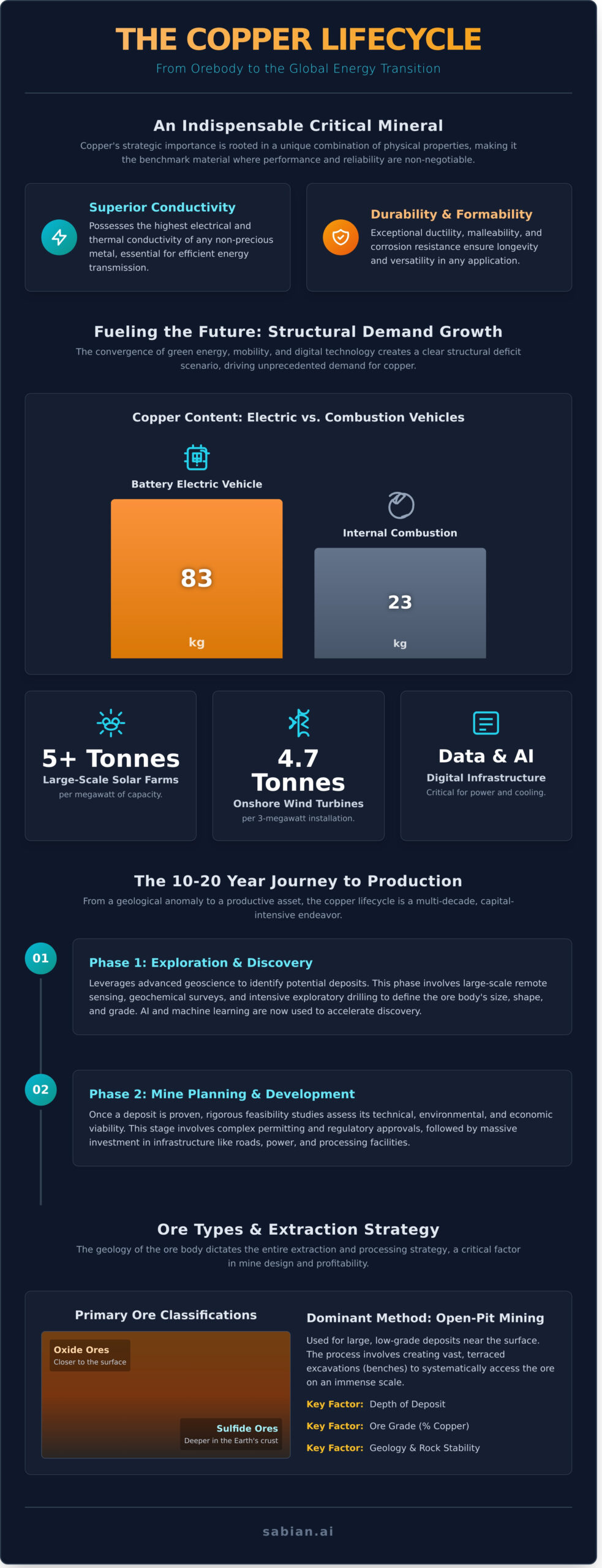
Copper’s strategic importance is rooted in a unique combination of physical properties that are difficult to replicate or substitute at scale in critical applications. Its superiority is undeniable:
- Superior Conductivity: Possessing the highest electrical and thermal conductivity of any non-precious metal, it is the benchmark for efficient energy transmission and heat exchange.
- Durability & Formability: Exceptional ductility, malleability, and corrosion resistance ensure longevity and versatility, allowing it to be drawn into fine wires or formed into complex components.
This synergy of attributes makes it the material of choice for high-stakes systems where performance and reliability are non-negotiable.
Future Demand Drivers: Electrification and Technology
The primary vectors of future copper demand are deep electrification and the expansion of advanced digital infrastructure. The statistics are stark: an average battery electric vehicle (EV) requires approximately 83 kg of copper, over 3.5 times the 23 kg found in a conventional internal combustion engine vehicle. This demand is magnified exponentially in renewable energy infrastructure. A single 3-megawatt onshore wind turbine can contain up to 4.7 tonnes of copper, while large-scale solar farms require over 5 tonnes per megawatt of capacity. Furthermore, the exponential growth of data centers and AI infrastructure-systems defined by their immense power and cooling requirements-relies critically on copper for efficient, high-density wiring and thermal management.
This convergence of demand from green energy, mobility, and digital technology creates a clear structural deficit scenario. Meeting this global challenge requires a fundamental re-evaluation of operational efficiency and resource intelligence within the copper mining sector. Maximizing profitability is no longer just a business objective; it is a strategic imperative for enabling the future global economy. The velocity and success of the energy transition will be directly correlated to the productivity of modern copper mining.
The Copper Mining Lifecycle: From Exploration to Extraction
The journey from a geological anomaly to a productive asset is a multi-decade endeavor, often requiring 10-20 years and billions in capital before the first ton of copper is produced. The copper mining lifecycle unfolds across four distinct, capital-intensive phases: exploration, development, operation, and eventual closure and reclamation. Central to the entire economic equation is the concept of ‘ore grade’-the concentration of copper within the rock, typically expressed as a percentage. While high-grade deposits might contain over 1.5% copper, many modern mines operate profitably on grades below 0.5%. This single metric dictates the volume of material that must be moved and processed, fundamentally shaping a project’s viability.
Phase 1: Exploration and Deposit Discovery
This initial phase leverages advanced geoscience to identify potential copper deposits. It begins with large-scale remote sensing and geochemical surveys to pinpoint target areas. Promising sites then undergo intensive exploratory drilling to define the size, shape, and grade of the ore body. Today, predictive intelligence platforms utilizing AI and machine learning are revolutionizing this process, analyzing vast geological datasets to accelerate discovery and de-risk investment.
Phase 2: Mine Planning and Development
Once a deposit is proven, a rigorous planning phase begins. Comprehensive feasibility studies assess technical, environmental, and economic viability. This stage involves navigating a complex web of permitting and regulatory approvals, a process where standards from bodies representing The Global Copper Industry are increasingly critical. Following approval, massive investment is directed toward constructing essential infrastructure, including access roads, power grids, and processing facilities.
The geological characteristics of the ore body, identified during exploration, dictate the entire subsequent extraction and processing strategy. A critical distinction is made between two primary types of copper ore: sulfide ores, found deeper within the earth’s crust, and oxide ores, which are typically located closer to the surface. Each type demands a fundamentally different metallurgical process, a crucial factor in mine design and profitability.
Extraction Methods: How Copper Ore is Mined
The profitability of any copper mining operation is fundamentally tied to the efficiency of its extraction strategy. The selection of a mining method is a critical, data-driven decision, dictated by the unique characteristics of the ore body. Key geological factors determine the approach:
- Depth of Deposit: How far below the surface the valuable ore is located.
- Ore Grade: The concentration of copper within the rock.
- Geology and Geomechanics: The stability and composition of the surrounding rock mass.
Modern extraction operates on an immense scale, moving millions of tonnes of material. This logistical challenge is met with advanced heavy machinery, increasingly guided by automation and predictive intelligence to optimize every cycle.
Open-Pit Mining
For large, low-grade porphyry copper deposits situated near the surface, open-pit mining is the dominant global method. This technique involves creating a vast, terraced excavation, known as benches, to systematically access the ore. The process is predicated on scale: controlled blasting fractures the rock, which is then loaded by enormous electric shovels into haul trucks capable of carrying over 400 tonnes per load. Its prevalence is due to its cost-effectiveness for massive, disseminated ore bodies.
Underground Mining
When ore bodies are located deep underground or are of a higher grade and more concentrated geometry, underground mining becomes the necessary approach. Techniques such as block caving, where large sections of ore are undercut to collapse under their own weight, or various forms of stoping (excavating ore between different levels) are employed. While these methods involve higher upfront capital and operational costs, they create a significantly smaller surface footprint and can precisely target high-value veins.
Regardless of the extraction method, the goal is to deliver ore to the processing plant. The mineralogy of this ore-primarily oxide or sulfide-dictates the specific copper processing methods required to liberate the metal. Both open-pit and underground operations rely on a fleet of sophisticated, automated equipment to ensure safety and maximize throughput.
From Ore to Metal: The Two Paths of Copper Processing
The transformation of low-grade ore into high-purity metal is the most complex and value-intensive stage in the copper mining lifecycle. The optimal processing route is dictated entirely by the ore’s mineralogy-specifically, whether the copper is locked in sulfide or oxide minerals. This fundamental distinction creates two primary metallurgical pathways: high-temperature pyrometallurgy and aqueous-based hydrometallurgy.
Success hinges on mastering processes like beneficiation, where ore is upgraded into a valuable concentrate, and subsequent chemical transformations like smelting or leaching to isolate the copper.
Pyrometallurgy: The High-Temperature Path for Sulfide Ores
Dominating the industry, pyrometallurgy is the energy-intensive process required for sulfide ores, which account for the vast majority of the world’s copper resources. The multi-stage journey involves:
- Concentration: Ore is crushed, ground, and subjected to froth flotation, a beneficiation process that creates a copper concentrate with a purity of approximately 30%.
- Smelting: The concentrate is heated to extreme temperatures in a furnace, producing a molten copper-iron sulfide mixture called ‘matte’ and separating out waste rock as slag.
- Converting & Refining: Air is blown through the molten matte to remove remaining sulfur and iron, creating anode copper of roughly 99% purity.
- Electro-refining: Anodes are dissolved in an electrolytic solution and re-plated onto pure cathodes, achieving a final LME-grade purity of 99.99% or higher.
Hydrometallurgy: The Aqueous Route for Oxide Ores
Hydrometallurgy is a chemical-based alternative designed for oxide and certain secondary sulfide ores. While less energy-intensive, its applicability is strictly limited by ore geology. The typical SX-EW (Solvent Extraction-Electrowinning) circuit includes:
- Leaching: Crushed ore is irrigated with a weak sulfuric acid solution, which dissolves the copper and carries it into a “pregnant” leach solution (PLS).
- Solvent Extraction (SX): The PLS is mixed with an organic solvent that selectively bonds with and extracts the copper ions, purifying and concentrating the solution.
- Electrowinning (EW): The copper is stripped from the solvent into a strong electrolyte, from which it is plated directly onto cathodes using an electric current.
Choosing and optimizing these metallurgical circuits is a high-stakes decision central to profitability. Predictive intelligence is no longer an advantage but a necessity. Advanced AI platforms, like those engineered at sabian.ai, are mission-critical for maximizing recovery and minimizing operational costs in today’s complex copper mining operations.
The Future of Copper Mining: Technology and Sustainability
The trajectory of the copper mining industry is being reshaped by formidable, converging pressures. As global demand for copper intensifies, operators face the dual challenge of declining resource quality and escalating ESG (Environmental, Social, and Governance) mandates. Navigating this future requires a fundamental shift from traditional methods to a data-driven, technologically advanced operational model. Profitability is no longer just about volume; it is about precision, efficiency, and sustainability.
Challenge: Declining Ore Grades and Deeper Mines
The era of easily accessible, high-grade copper deposits is ending. Globally, average ore grades are diminishing, forcing operations to move and process significantly more rock to extract the same amount of metal. This reality directly inflates operational costs through higher energy consumption, increased water usage, and greater mechanical wear. In this environment, brute force is inefficient; surgical precision is the key to maintaining financial viability.
Challenge: ESG and the Social License to Operate
Simultaneously, the social license to operate is now contingent on demonstrable environmental stewardship. Stakeholders-from investors to local communities-demand accountability on critical ESG metrics. This includes minimizing water consumption, reducing carbon footprints, ensuring responsible tailings management, and executing comprehensive mine reclamation plans. Transparency is paramount; operators must leverage verifiable data to build and maintain trust.
Solution: The Rise of AI and Predictive Intelligence
Advanced technology is the definitive solution to these challenges. Artificial Intelligence and Predictive Intelligence are transitioning from conceptual ideas to essential operational assets in modern copper mining. By integrating vast datasets from across the value chain-from geological models to real-time sensor readings in the processing plant-AI delivers a new level of operational command.
This intelligence enables predictive maintenance to eliminate unplanned downtime, stabilizes complex chemical processes to maximize recovery rates, and optimizes resource allocation with unparalleled accuracy. It transforms data from a byproduct into a primary driver of efficiency and sustainability. Discover how AI is transforming mineral intelligence.
Powering the Future with Intelligent Copper Mining
The journey from raw ore to refined metal reveals the immense complexity and critical importance of copper. This essential element, foundational to global electrification and technological progress, follows an intricate lifecycle of discovery, extraction, and processing. As global demand accelerates, the traditional model of copper mining is evolving, driven by the urgent need for enhanced efficiency, sustainability, and operational precision.
This evolution is powered by advanced technology. As Pioneers in AI for Critical Minerals, Sabian.ai provides the definitive Predictive Intelligence Platform for the entire mining value chain. By leveraging sophisticated AI, operators can de-risk exploration, optimize processing, and maximize yield with unparalleled accuracy. This is the new frontier of resource extraction-one defined by data, not just brute force.
Embrace the future of mining intelligence. Explore the Sabian AI platform for predictive intelligence in mining and begin engineering the next era of operational excellence.
Frequently Asked Questions
What is the environmental impact of copper mining?
Copper extraction inherently impacts ecosystems through land disturbance, water usage, and potential contamination from tailings and acid rock drainage. Smelting processes can also release sulfur dioxide. However, modern operations are increasingly mandated to implement advanced mitigation strategies. These include sophisticated water treatment facilities, progressive land rehabilitation programs, and technologies that capture emissions, significantly reducing the operational footprint and moving towards a more sustainable extraction model.
How long does a typical copper mine operate?
The operational lifespan of a copper mine is highly variable, typically ranging from 20 to 50 years, with some major deposits operating for over a century. Key determinants include the size and grade of the ore body, prevailing copper prices, and the efficiency of extraction technologies. As high-grade surface deposits are depleted, advanced technologies become critical for extending mine life by enabling the economic extraction of lower-grade or deeper ore deposits.
Which country is the largest producer of copper?
Chile is the undisputed global leader in copper production, consistently accounting for over 25% of the world’s total output. Its vast porphyry copper deposits, particularly in the Atacama Desert, are the primary source of this dominance. Other significant producers include Peru, China, and the Democratic Republic of Congo, but Chile’s production scale remains unparalleled in the global market, making it a critical node in the supply chain for this essential industrial metal.
What is the difference between copper ore, concentrate, and cathode?
These terms represent distinct stages in the copper production value chain. Copper ore is the raw rock extracted from the earth, containing low percentages of copper (typically less than 1%). This ore is then crushed and processed to create copper concentrate, a refined powder with a much higher copper content (20-30%). Finally, through smelting and refining, this concentrate is transformed into copper cathode, which is over 99.99% pure copper and ready for industrial fabrication.
Can copper be recycled, and how does it affect mining?
Copper is infinitely recyclable without any loss of its chemical or physical properties, making it a cornerstone of the circular economy. This secondary production from recycled scrap currently satisfies over 30% of global copper demand. While this reduces the immediate pressure for new primary extraction, the escalating global demand for copper, driven by electrification and green technologies, ensures that new copper mining operations remain strategically essential for securing a stable long-term supply.
How is Artificial Intelligence (AI) being used to improve copper mining operations?
Artificial Intelligence is revolutionizing copper mining by shifting operations from reactive to predictive models. AI algorithms analyze vast geological datasets to identify high-potential exploration targets with greater accuracy. In operations, AI optimizes haul truck fleet management, fine-tunes mineral processing parameters in real-time for maximum yield, and enables predictive maintenance on critical equipment. This data-driven approach significantly enhances efficiency, safety, and profitability across the entire value chain.