
Hi, this is a comment. To get started with moderating, editing, and deleting comments, please visit the Comments screen in…
China’s October
2026 Rare Earth Export Controls: A Strategic Analysis
China's October 2025 Rare Earth Export Controls: A Strategic
Analysis Electric Vehicles (EVs): The production of high-efficiency

China’s October 2025 Rare Earth Export Controls: A Strategic Analysis
- Electric Vehicles (EVs): The production of high-efficiency Neodymium Magnets for EV motors is heavily reliant on neodymium and praseodymium (NdPr). Supply disruptions directly threaten EV production targets and profitability for major automakers.
Geopolitical tremors are reshaping the critical minerals landscape. The announcement of China’s rare earth export controls for October 2025 is not merely a regulatory update; it is a strategic maneuver with profound implications for global industry. For leaders in technology, defense, and renewable energy, navigating this new reality is paramount. The stability of production lines and the future of technological advantage hang in the balance. Ambiguity is not an option when material shortages and price volatility threaten operational integrity.
This strategic analysis decodes the new regulations, offering a data driven assessment of their market impact. We will dissect the scope of the restrictions, model potential supply chain disruptions, and outline actionable strategies for mitigating geopolitical risk. Gain the predictive intelligence necessary to de-risk your operations and make confident sourcing and technology investment decisions in this new era of mineral statecraft.
Deconstructing the October 2025 Controls: What You Need to Know
The announcement from China’s Ministry of Commerce (MOFCOM) marks a paradigm shift in global resource governance. The china rare earth export controls October 2025 move beyond the previous, more predictable quota systems, implementing a sophisticated, license based framework designed for precise geopolitical leverage. This new architecture grants Beijing granular control over not just the raw materials but the entire high tech value chain that depends on them, fundamentally altering the strategic calculus for industries worldwide.
Scope of Controlled Items
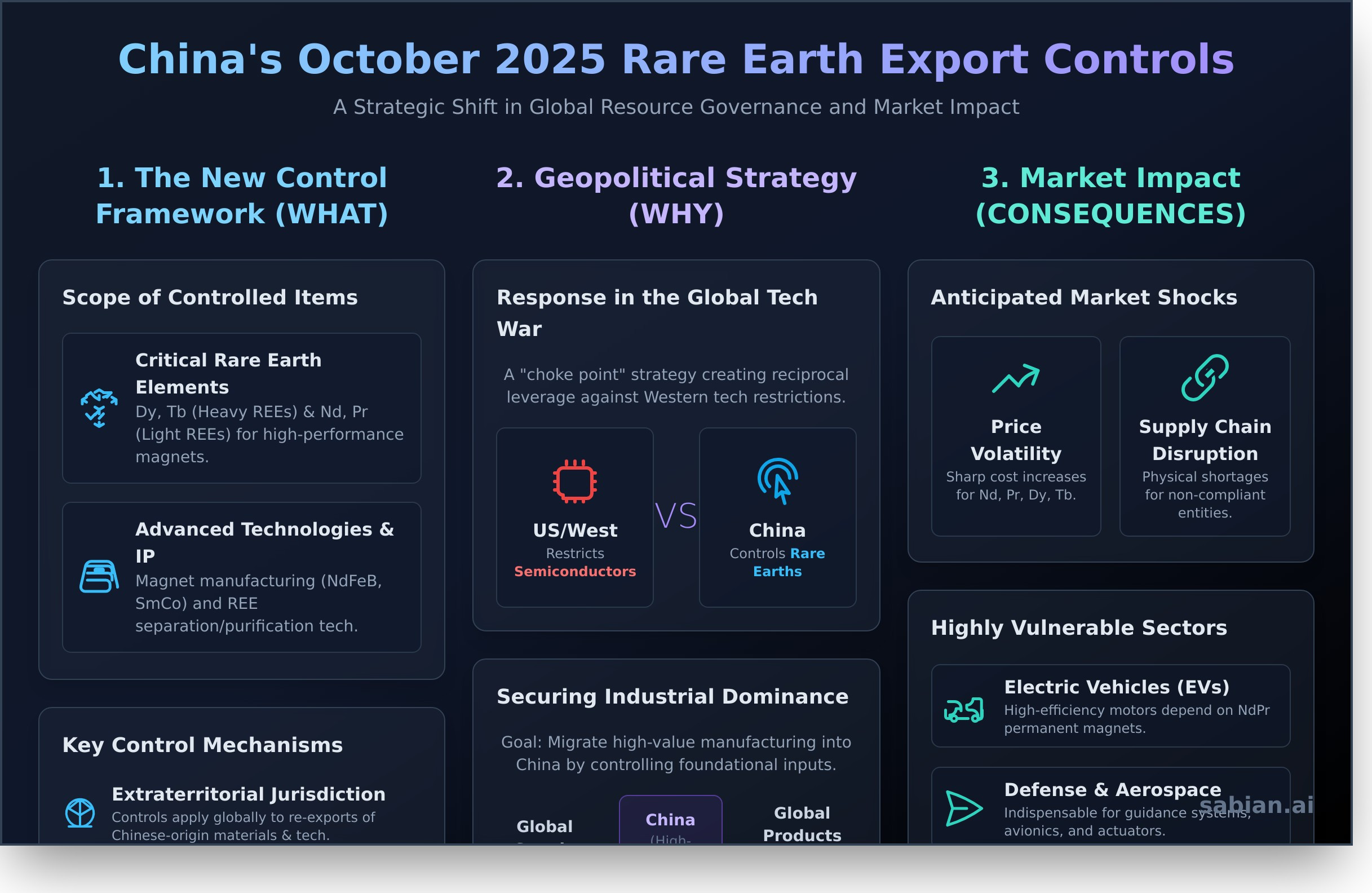
The controls are strategically targeted to impact high performance applications critical to defense, green energy, and consumer electronics. The scope is twofold, encompassing both materials and the intellectual property required to utilize them:
-
Critical Rare Earth Elements (REEs): The list specifically targets heavy rare earths like dysprosium and terbium, essential for high temperature magnet performance, alongside light rare earths like neodymium and praseodymium, which form the core of the world’s most powerful permanent magnets.
-
Advanced Technologies: The controls extend to the technology for manufacturing high performance sintered NdFeB and SmCo permanent magnets. Crucially, they also cover the proprietary technologies for the separation and purification of critical rare earth elements, striking at the heart of non-Chinese processing ambitions.
The Extraterritorial Jurisdiction Clause
Perhaps the most significant aspect of the new regulations is their assertion of extraterritorial jurisdiction. This means the controls apply not only to exports originating from China but also to the re-export of Chinese origin REE materials or technologies by non Chinese entities operating anywhere in the world. This clause forces global manufacturers to track and verify their supply chains with unprecedented diligence, creating complex compliance challenges and potentially isolating supply chains that are deemed non compliant by Beijing.
Licensing Process and ‘Presumptive Denial’
Acquiring an export license now involves a rigorous application process through MOFCOM, requiring exhaustive documentation on end users and specific end-use applications. This system is a major evolution from the blunt instrument of quotas that characterized China’s rare earth industry in the past. The core of this new mechanism is the principle of ‘presumptive denial,’ particularly for applications linked to foreign military or dual-use technologies. This ambiguity introduces significant operational uncertainty, allowing for selective enforcement that aligns with China’s strategic interests and creating a powerful deterrent for companies involved in sensitive sectors.
Geopolitical Context: The Strategy Behind the Restrictions
The impending china rare earth export controls october 2025 are not an isolated trade policy but a calculated maneuver in a protracted geopolitical contest. Beijing’s strategy is multifaceted, leveraging its near-monopoly on rare earth element (REE) processing to counter Western technological containment, secure its industrial future, and conserve strategic national resources. This is not a new tactic; China has previously used REEs as a tool of statecraft, most notably against Japan in 2010. The current restrictions, however, represent a significant escalation in scope and strategic intent, aimed squarely at the core of global high-technology value chains.
A Response in the Global Tech War
These export controls are a direct and asymmetrical response to US led restrictions on semiconductor technology. Where Washington targets China’s access to high end chips, Beijing counters by targeting the foundational inputs for the entire advanced technology ecosystem. This is a classic ‘choke point’ strategy. By regulating the flow of critical materials like dysprosium and terbium essential for high-performance magnets China is asserting control over a different, yet equally vital, node in the global supply chain. The policy functions as a form of reciprocal measure, signaling that technological decoupling carries significant costs for all participants.
Securing Industrial Dominance
Beyond geopolitical retaliation, the controls are a core component of China’s industrial strategy. The primary goal is to accelerate the migration of high-value manufacturing into China. By making processed REEs more accessible and affordable domestically than abroad, Beijing creates a powerful incentive for global leaders in sectors like electric vehicles (EVs), wind turbines, and advanced defense systems to onshore their production. This strategy amplifies global dependencies, a trend confirmed by recent IEA analysis on supply concentration risks, and forces international firms to invest in China to secure access. Ultimately, the china rare earth export controls October 2025 are designed to transform the nation from the world’s mine to its preeminent high-tech manufacturer.
Market Impact: Price Volatility and Supply Chain Disruption
The implementation of china rare earth export controls October 2025 is projected to send a systemic shock through global markets, triggering immediate price volatility and exposing critical supply chain vulnerabilities. As the world’s dominant producer, China’s decision to restrict the flow of rare earth elements (REEs) and associated technologies creates significant uncertainty for downstream industries. The primary impact will be a sharp increase in the cost of essential REEs like neodymium and dysprosium, coupled with potential physical shortages for nations unable to secure alternative supplies.
Vulnerability of Key Sectors
The ripple effects of these controls will be felt most acutely in high technology and strategic manufacturing sectors. The dependency is concentrated in components where no viable substitutes currently exist at scale.
-
Electric Vehicles (EVs): The production of high-efficiency permanent magnets for EV motors is heavily reliant on neodymium and praseodymium (NdPr). Supply disruptions directly threaten EV production targets and profitability for major automakers.
-
Defense & Aerospace: REEs are indispensable for critical defense applications, including precision-guided munitions, drone motors, and advanced radar and sonar systems. Securing these materials is a matter of national security.
-
Consumer Electronics: From the tiny magnets in smartphone speakers and haptic engines to those in computer hard drives, the consumer electronics industry faces significant cost pressures and potential production bottlenecks.
Price and Investment Forecasts
Market analysts predict a period of intense price instability following the enactment of the controls. This environment will catalyze a global recalibration of investment in the critical minerals sector. We anticipate a significant surge in capital allocation toward non Chinese mining, separation, and magnet manufacturing projects, particularly in Australia, Canada, and the United States. Consequently, the stock prices of publicly traded REE exploration and processing firms outside China are expected to experience heightened volatility and potential upward revaluation as they become central to new supply chain strategies.
International Response and Policy Shifts
Major economies are accelerating policy initiatives to counter the geopolitical leverage exerted by these export controls. Nations are drawing lessons from previous supply shocks, understanding the geopolitical context of rare earth restrictions to formulate more resilient national strategies. Governments in the US, EU, and Japan are deploying a multi-pronged approach: establishing strategic national stockpiles, offering robust financial incentives for domestic mining and processing, and reinforcing alliances with resource-rich partner nations. The potential for filing disputes at the World Trade Organization (WTO) remains a viable, albeit protracted, diplomatic option. For corporations, navigating this uncertainty requires advanced predictive intelligence to de-risk supply chains and identify new sourcing opportunities.
Strategic Mitigation: Building a Resilient Supply Chain with AI
The impending china rare earth export controls october 2025 represent a fundamental shift in the global materials landscape, not a temporary disruption. For corporations reliant on Rare Earth Elements (REEs), short term stockpiling is an insufficient response. The imperative is to architect a new, resilient, and technologically advanced supply chain. This requires accelerating ‘China Plus One’ sourcing strategies and embedding predictive intelligence into the core of procurement and operations.
Diversification and Onshoring Efforts
Geopolitical alignment is driving the development of new REE projects in allied nations like Australia, Canada, and the United States. While promising, these initiatives face significant headwinds: the immense capital investment and technical expertise required to build complex processing and refining facilities cannot be overstated. Simultaneously, a robust circular economy focused on recycling REEs from e-waste and industrial magnets is critical, but it can only supplement, not replace, the need for primary production.
The Role of AI in De-risking Operations
Technology is the critical enabler to overcoming these challenges and de-risking new ventures. Artificial intelligence is fundamentally changing the economic viability of non Chinese REE sources. AI driven platforms can:
-
Optimize mineral exploration by analyzing vast geological datasets to pinpoint high potential deposits with greater speed and accuracy.
-
Stabilize the notoriously complex chemistry of REE refining through advanced process control, increasing purity and yield.
-
Maximize recovery rates from ore, transforming previously marginal or uneconomical deposits into viable assets.
From Reactive to Predictive Intelligence
The ultimate evolution is moving from a reactive posture to a predictive one. Instead of responding to supply chain shocks, leading organizations are using AI to anticipate them. Advanced platforms can model the impact of geopolitical events, forecast production bottlenecks, and identify hidden vulnerabilities across multi-tiered supplier networks. This foresight transforms supply chain risk from a liability into a source of profound competitive advantage, ensuring operational continuity in the face of events like the China rare earth export controls October 2025. Transform supply chain risk into predictive intelligence with Sabian AI.
Navigating the Post-2025 Landscape: From Geopolitical Risk to Strategic Advantage
The impending china rare earth export controls October 2025 are not a temporary market fluctuation; they represent a calculated geopolitical maneuver designed to reshape global high-tech industries. For organizations reliant on these critical minerals, the consequences are clear: significant price volatility and profound supply chain disruption. Simply diversifying sourcing is no longer a sufficient strategy. The path forward demands a fundamental shift from reactive measures to proactive, intelligence-driven resilience.
In this new era, traditional risk management is obsolete. Securing a competitive advantage requires moving beyond reaction to prediction. Sabian.ai’s AI platform for mining optimization delivers the Predictive Intelligence necessary to forecast market shifts, de-risk operations, and build true global supply chain resilience. Gain Predictive Intelligence on Your Critical Minerals Supply Chain and transform uncertainty into strategic opportunity.
The future belongs to those who can anticipate the next move. It’s time to build a more resilient and intelligent supply chain.
Frequently Asked Questions
Which specific rare earth elements are most affected by the October 2025 controls?
The China rare earth export controls October 2025 strategically target heavy rare earth elements (HREEs) critical for advanced defense and green energy technologies. Specifically, dysprosium (Dy) and terbium (Tb), essential additives for high performance permanent magnets used in electric vehicles and wind turbines, face the most stringent restrictions. While not HREEs, neodymium (Nd) and praseodymium (Pr) supply chains will also experience significant disruption due to their symbiotic relationship in magnet manufacturing.
How do these new export controls differ from China’s previous rare earth quota system?
The previous quota system focused on aggregate export volumes, a blunt instrument for managing supply. The new export controls represent a paradigm shift towards a more sophisticated licensing framework. This system requires exporters to detail end-users and end-use applications, granting Beijing granular control over who receives these strategic materials. It moves from managing quantity to strategically directing the flow of critical technology inputs based on national security and industrial policy objectives.
What is the direct impact on non-Chinese companies that manufacture products within China?
Non-Chinese companies manufacturing within China are no longer insulated from supply chain volatility. They will face heightened scrutiny and complex licensing requirements, potentially leading to significant production delays. The new regulations prioritize domestic champions and strategic partners, meaning foreign owned enterprises may experience allocation shortfalls or outright denials for critical rare earth inputs. This erodes the long-held assumption that on shore production guarantees supply chain security for these entities.
Are there viable alternative sources to China for rare earth elements and processing?
Alternative mining sources are emerging in Australia, the United States, and Canada. However, the critical bottleneck is not extraction but mid-stream processing and refining-a domain where China maintains over 85% global market share. While projects like the Mountain Pass facility in the U.S. are building out this capacity, achieving commercial scale, cost competitive processing independence remains a multi year challenge. A complete decoupling from Chinese processing infrastructure is not yet a near-term reality.
How can advanced technologies like AI realistically help mitigate these supply chain risks?
AI-driven predictive intelligence offers a direct countermeasure to this strategic uncertainty. Machine learning models can accelerate the discovery of new deposits outside China by analyzing vast geological datasets. In processing, AI optimizes complex separation chemistries, increasing yields and economic viability for Western facilities. Furthermore, AI platforms can model supply chain dynamics, providing early warnings of disruptions and enabling proactive procurement and substitution strategies before crises fully materialize.
What does the ‘extraterritorial jurisdiction’ clause mean for a company based in Europe or North America?
The extraterritorial jurisdiction clause means the China rare earth export controls October 2025 can apply to a company’s global operations, not just its dealings within China. A European or North American firm that procures these materials even through a third party and uses them in applications deemed contrary to China’s national security interests (e.g., advanced defense systems) could face sanctions. This effectively extends Beijing’s regulatory authority beyond its borders, creating significant compliance and geopolitical risk.