
Hi, this is a comment. To get started with moderating, editing, and deleting comments, please visit the Comments screen in…
The Mining
Industry: A Comprehensive Guide to Its Operations, Challenges, and Future
The global mining industry operates on a colossal scale,
a foundational pillar of modern civilization. Yet, for

The global mining industry operates on a colossal scale, a foundational pillar of modern civilization. Yet, for many, its inner workings remain opaque a complex web of technical processes, volatile market drivers, and significant environmental considerations. This lack of clarity can be a formidable barrier for students seeking to understand the sector, investors assessing risk, and professionals aiming to navigate its future.
This comprehensive guide is engineered to provide that clarity. We will dissect the complete mining lifecycle, from advanced geological exploration to final site reclamation. You will gain a strategic understanding of the critical economic and environmental trends shaping the industry’s trajectory. Most importantly, we will analyze the role of transformative technology in creating a more efficient, precise, and sustainable future. This is your blueprint for acquiring the intelligence needed to make informed decisions in this pivotal global sector.
The Mining Lifecycle: From Discovery to Reclamation
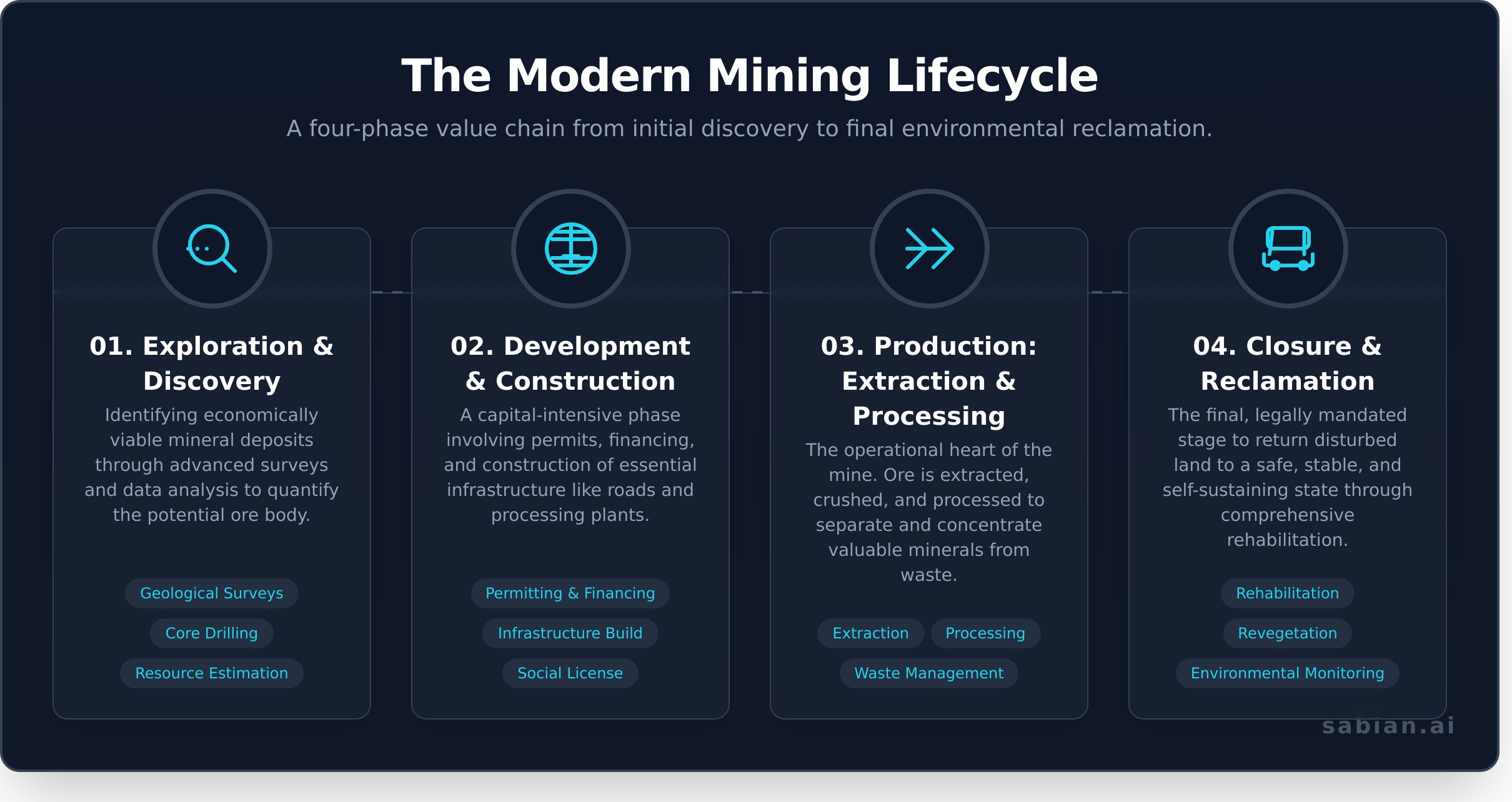
A modern mine operates on a finite lifecycle, a multi decade value chain that progresses from initial discovery to final reclamation. Each phase represents a complex system with immense potential for optimization through predictive intelligence and advanced analytics. This process, which forms the operational core of the modern Comprehensive overview of the mining industry, demands massive long-term investment and strategic planning, often spanning decades before a return is realized.
Exploration and Discovery
This initial phase targets the identification of economically viable mineral deposits. It leverages advanced geological surveys, satellite remote sensing, and geophysical analysis to pinpoint promising targets. Subsequent core drilling and systematic sampling are critical for resource estimation, allowing geologists to quantify the potential ore body’s grade, tonnage, and metallurgical characteristics. This data-intensive stage determines whether a prospect merits further investment.
Development and Construction
Once a deposit is proven viable, the project enters a capital intensive development phase. This involves securing complex environmental permits, substantial financing, and a crucial social license to operate from local communities. Capital is deployed to construct essential infrastructure, including access roads, power facilities, and sophisticated processing plants. This stage represents a significant financial commitment long before any revenue is generated.
Production: Extraction and Processing
The production phase is the operational heart of a mine, where value is actively generated. This stage involves two primary activities:
-
Extraction: The systematic removal of ore from the ground using either surface (open-pit) or underground mining techniques.
-
Processing: The ore is crushed, ground, and subjected to metallurgical processes to separate and concentrate the valuable minerals from waste rock (tailings).
Efficient management of ore flow, energy consumption, and waste streams is paramount for profitability and environmental compliance.
Closure and Reclamation
The final, legally mandated stage of the mining lifecycle is closure and reclamation. The objective is to return the disturbed land to a safe, stable, and often self-sustaining state. This involves dismantling infrastructure, re-contouring landscapes, and executing comprehensive rehabilitation and revegetation programs. Continuous environmental monitoring and significant financial assurances are required to ensure long-term ecological stability, concluding the mine’s operational footprint.
Core Mining Methods and Key Commodities
The operational core of the mining industry is the physical extraction of valuable minerals from the earth. The geological architecture of an ore deposit dictates the extraction method, a critical decision balancing economic viability, safety, and environmental impact. Selecting the optimal approach is a complex variable analysis, a process now being revolutionized by predictive modeling and advancements in AI and automation in the mining industry, which enhance precision from exploration to processing.
Surface vs. Underground Mining
The primary distinction in extraction methodology is determined by the depth and geometry of the orebody. When mineral deposits are located near the surface, surface mining is the economically superior paradigm. Conversely, deeper deposits necessitate the capital-intensive and technically complex operations of underground mining.
-
Surface Mining: This category includes methods like open-pit mining for large, consolidated orebodies (e.g., copper), strip mining for layered deposits (e.g., coal), and quarrying for construction materials like granite and marble.
-
Underground Mining: For deep orebodies, methods include room and pillar mining, which leaves pillars of ore to support the mine roof; longwall mining for continuous extraction of coal seams; and block caving, which uses gravity to break up large, deep orebodies.
Major Commodity Groups
The output of global mining operations can be classified into several key groups based on their industrial and economic applications. These commodities form the foundational materials for nearly every sector of the global economy.
-
Base Metals: The building blocks of industrial infrastructure, including copper, lead, zinc, and nickel.
-
Precious Metals: Valued for their rarity and use in investment, jewelry, and high-tech electronics. This group includes gold, silver, and platinum group metals (PGMs).
-
Industrial Minerals: A broad category of materials essential for agriculture and construction, such as potash, salt, sand, and gravel.
The Rise of Critical Minerals and Rare Earths
A new strategic imperative is reshaping the mining industry: the secure supply of critical minerals. These are elements defined as essential to economic and national security, particularly for high-technology, renewable energy, and defense applications. This group includes minerals like **lithium, cobalt, and manganese **the core components of battery technology for electric vehicles (EVs) and the 17 rare earth elements (REEs) vital for high strength magnets used in wind turbines and advanced electronics. Their strategic importance has elevated their extraction from a commercial activity to a matter of geopolitical significance.
Megatrends Redefining the Global Mining Industry
The global mining industry is at a critical inflection point, shaped by powerful external forces that are transforming its strategic landscape. These megatrends are not merely creating new operational challenges; they are compelling a fundamental evolution, driving unprecedented innovation and technological adoption. The industry is moving beyond its traditional role of extraction to become the foundational enabler of global economic and energy transitions.
The Energy Transition
The global shift toward a low-carbon economy is fundamentally a resource shift, placing mining at the epicenter of decarbonization. The exponential demand for critical minerals including lithium and cobalt for batteries, copper for electrification, and rare earth elements for wind turbines is projected to surge. The core challenge is scaling production to meet this demand sustainably, requiring advanced exploration technologies and operational efficiencies to minimize environmental impact.
ESG and the Social License to Operate
Stakeholder expectations have irrevocably changed, making Environmental, Social, and Governance (ESG) performance a non-negotiable prerequisite for success. The "social license to operate" is now a core business imperative, demanding demonstrable progress in key areas:
-
Environmental: Aggressive decarbonization of operations, circular water management, and proactive biodiversity protection.
-
Social: Equitable community engagement, stringent protection of labor rights, and transparent benefit-sharing agreements.
-
Governance: Unwavering commitment to transparency, anti-corruption protocols, and ethically verifiable supply chains.
Geopolitics and Supply Chain Security
The geographic concentration of mineral production and processing has created significant supply chain vulnerabilities. As nations increasingly view these resources through a strategic lens, the risks of resource nationalism and trade disruptions are escalating. This geopolitical volatility is driving a concerted push to onshore or "friend shore" critical mineral supply chains, de-risking access for key industries. Understanding these complex dependencies requires authoritative data from organizations like the U.S. Geological Survey Mineral Resources program to map and forecast global flows. Navigating this new landscape demands predictive intelligence to secure future resources, a challenge at the core of platforms like sabian.ai.
The Technological Revolution: AI and Automation in Mining
The modern mining industry is at a critical inflection point, confronted by the megatrends of decarbonization, stringent safety standards, and declining ore grades. The strategic response to these challenges is not incremental improvement but a wholesale technological revolution. In this new paradigm, data has surpassed the mineral itself as the most valuable extracted resource, forming the foundation for unprecedented gains in efficiency, safety, and sustainability.
From Automated Haulage to Autonomous Operations
The most visible transformation is the shift from manual labor to intelligent automation. Automated haulage trucks, drills, and trains now operate with superhuman precision and consistency, removing personnel from the most hazardous environments. This is enabled by a vast network of IoT sensors that feed real-time data into a "digital twin" a virtual replica of the entire mine. This allows operators to simulate, predict, and optimize operations remotely, paving the way for the ultimate goal: fully autonomous, lights-out mining.
The Power of Predictive Intelligence with AI
Artificial intelligence is unlocking a new frontier of operational excellence. Instead of reacting to equipment failure, AI driven predictive maintenance forecasts potential breakdowns in critical assets like crushers and haul trucks, maximizing uptime and asset longevity. Machine learning algorithms analyze sensor data from complex processes like solvent extraction, optimizing chemical usage and recovery rates in real time. Furthermore, AI is revolutionizing exploration by refining geological models, increasing the probability of discovery and de-risking capital intensive projects.
AI-Driven Supply Chain and Market Intelligence
The impact of AI extends far beyond the mine site. In a volatile global market, predictive intelligence is essential for navigating supply chain complexities and commodity price fluctuations. Sophisticated AI models can now:
-
Forecast demand and potential supply chain disruptions.
-
Optimize logistics from pit to port, reducing costs and emissions.
-
Analyze geopolitical and market data to inform strategic decisions.
This level of foresight is no longer a competitive advantage; it is a necessity for survival and growth in the global
**mining industry
**. See how
[Sabian Technology platform
](https://sabian.ai/)delivers the predictive intelligence required to master these challenges.
Forging the Future: The Dawn of Intelligent Mining
The path from discovery to reclamation is being fundamentally reshaped by global pressures and unprecedented technological advancement. As traditional methods evolve, the integration of intelligent systems is no longer an option but a strategic imperative for survival and growth. This technological shift is defining the future of the mining industry, demanding a new class of tools built for precision and foresight.
Leading this charge is Sabian AI, the world’s first AI platform engineered specifically for the rare earth and critical minerals sector. Empowering producers and governments with true Predictive Intelligence, its specialized modules are designed to stabilize chemistry and significantly increase recovery rates. This is the strategic application of AI to solve the sector’s most complex challenges.
Discover the future of mining with Sabian AI’s predictive intelligence platform.
The next era of mining will be defined by those who harness data to unlock new levels of efficiency and sustainability. The tools to lead are now within reach.
Frequently Asked Questions About the Mining Industry
What is the economic importance of the mining industry?
The mining industry is the foundational pillar of the global economy, supplying the essential raw materials for nearly every advanced sector. From the iron ore and coking coal for steel infrastructure to the copper for electrical grids and the lithium for electric vehicle batteries, its output is indispensable. The sector is a critical driver of GDP, foreign investment, and high-value employment in resource rich nations, underpinning complex international supply chains and enabling technological progress on a global scale.
Is the mining industry bad for the environment?
Historically, mining operations have created significant environmental footprints. However, the modern mining industry operates under stringent environmental regulations and increasingly deploys advanced technologies for mitigation. These include sophisticated water recycling systems, real time emissions monitoring, and progressive rehabilitation plans to restore land post-extraction. The objective is to shift towards sustainable resource extraction, minimizing impact through data-driven environmental management and innovative reclamation strategies that were not previously possible.
How is safety managed in modern mining operations?
Modern mining safety has shifted from a reactive to a predictive, technology driven paradigm. Autonomous haulage systems and remote-controlled equipment remove personnel from high risk environments entirely. Furthermore, wearable sensors monitor worker vitals and environmental hazards in real time, while AI powered analytics can identify potential equipment failures or geotechnical instability before they occur. This fusion of automation and data intelligence creates a systematically safer operational environment by minimizing human exposure to risk.
What are the biggest challenges facing the mining industry today?
The primary challenges are multifaceted. Companies face intense pressure to meet stringent Environmental, Social, and Governance (ESG) mandates from investors and regulators. Concurrently, declining ore grades necessitate more advanced exploration and extraction technologies to maintain viability. Geopolitical instability also creates significant supply chain vulnerabilities, particularly for critical minerals. Overcoming these hurdles requires massive capital investment in digitalization, automation, and sustainable practices to ensure both profitability and a social license to operate.
Why are rare earth minerals so important for the future?
Rare Earth Elements (REEs) are indispensable components for the 21st century’s core technologies. They are critical for manufacturing the powerful permanent magnets used in electric vehicle motors and wind turbines, which are central to the global energy transition. REEs are also vital for consumer electronics, advanced defense systems, and medical imaging devices. Their unique magnetic and catalytic properties make them irreplaceable, positioning their secure supply as a matter of strategic national and economic importance.
How will AI and technology change mining in the next decade?
In the next decade, Artificial Intelligence will fundamentally re-engineer mining operations. AI-driven predictive intelligence will analyze vast geological datasets to pinpoint high potential mineral deposits with unprecedented accuracy, reducing exploration risk. Fully autonomous fleets will optimize haulage and extraction for maximum efficiency and safety. In processing, machine learning algorithms will continually adjust parameters to maximize mineral recovery rates, transforming the value chain into a highly optimized, data-centric, and predictive enterprise.