
Hi, this is a comment. To get started with moderating, editing, and deleting comments, please visit the Comments screen in…
Geometallurgy: Maximizing
Resource Value with AI-Driven Predictive Intelligence
The disconnect between the geological model and plant reality
represents one of the most significant value leaks

The disconnect between the geological model and plant reality represents one of the most significant value leaks in modern mining. Unexpected ore variability disrupts processing circuits, erodes recovery, and turns predictable forecasts into costly liabilities. For decades, the discipline of geometallurgy has sought to bridge this gap by integrating geological data with metallurgical performance. Yet, this conventional approach remains constrained by the limitations of slow, expensive, and sample-dependent lab work, creating a static view that fails to guide dynamic, real-time operations.
This article moves beyond those constraints. We explore the new frontier where AI-driven platforms like STRATA are transforming mineral processing from a reactive discipline into a predictive science. Go beyond the textbook definition to discover how to accurately forecast mill throughput and recovery, de-risk mine planning with unprecedented foresight, and unlock the true Net Present Value (NPV) of your orebody. It’s time to evolve from retrospective analysis to predictive intelligence and command the entire mine-to-mill value chain.
What is Geometallurgy? A Strategic Framework for the Mining Value Chain
In modern mining, uncertainty is the primary driver of risk and inefficiency. The foundational question of What is Geometallurgy is answered by viewing it as the strategic integration of geology, mining engineering, and extractive metallurgy. This multidisciplinary science moves beyond simply identifying ore grade to build a comprehensive, spatially aware understanding of how an orebody will behave during processing. Its primary objective is to create a predictive model that forecasts metallurgical performance block-by-block throughout the deposit.
This predictive capability is not an academic exercise; it is a critical tool for de-risking capital investments and optimizing operational performance. For greenfield projects, a robust geometallurgical model informs plant design and validates economic feasibility. For operating mines, it enables proactive planning, allowing for optimized blending strategies and more accurate production forecasting, transforming geological variability from a liability into a manageable variable.
Core Components of a Traditional Geometallurgical Program
A conventional program systematically translates geological data into processing parameters. This workflow involves several critical stages:
-
Geologically-Informed Sampling: Selecting drill core samples that are truly representative of the different rock types, alteration styles, and mineralization zones within the orebody.
-
Metallurgical Test Work: Conducting bench-scale and pilot-scale tests to measure key processing responses, such as comminution (crushing and grinding) hardness, flotation recovery, and leachability.
-
Proxy Development: Identifying relationships between easily measured geological properties (e.g., mineralogy, rock mechanics) and complex metallurgical performance to reduce the need for expensive, widespread testing.
-
Geostatistical Modeling: Using spatial statistics to interpolate and extrapolate test results and proxy data across the entire orebody, populating the resource block model with predictive processing attributes.
The Desired Output: From Block Model to Production Forecast
The ultimate output of a geometallurgy program is an enhanced block model that serves as the single source of truth for strategic planning. This intelligent model enables operators to:
-
Define Geometallurgical Domains: Delineate distinct zones within the orebody based on expected processing behavior, not just elemental grade.
-
Predict Key Performance Indicators (KPIs): Forecast critical operational metrics such as plant throughput, mineral recovery, concentrate quality, and reagent consumption for any part of the mine plan.
-
Inform Mine Planning: Optimize long-term mine schedules and short term blast plans to deliver a consistent and predictable blend of ore to the processing plant.
-
Underpin Financial Models: Provide a robust, data driven basis for project valuation, cash flow analysis, and strategic business decisions.
The Inherent Limitations of Conventional Geometallurgy
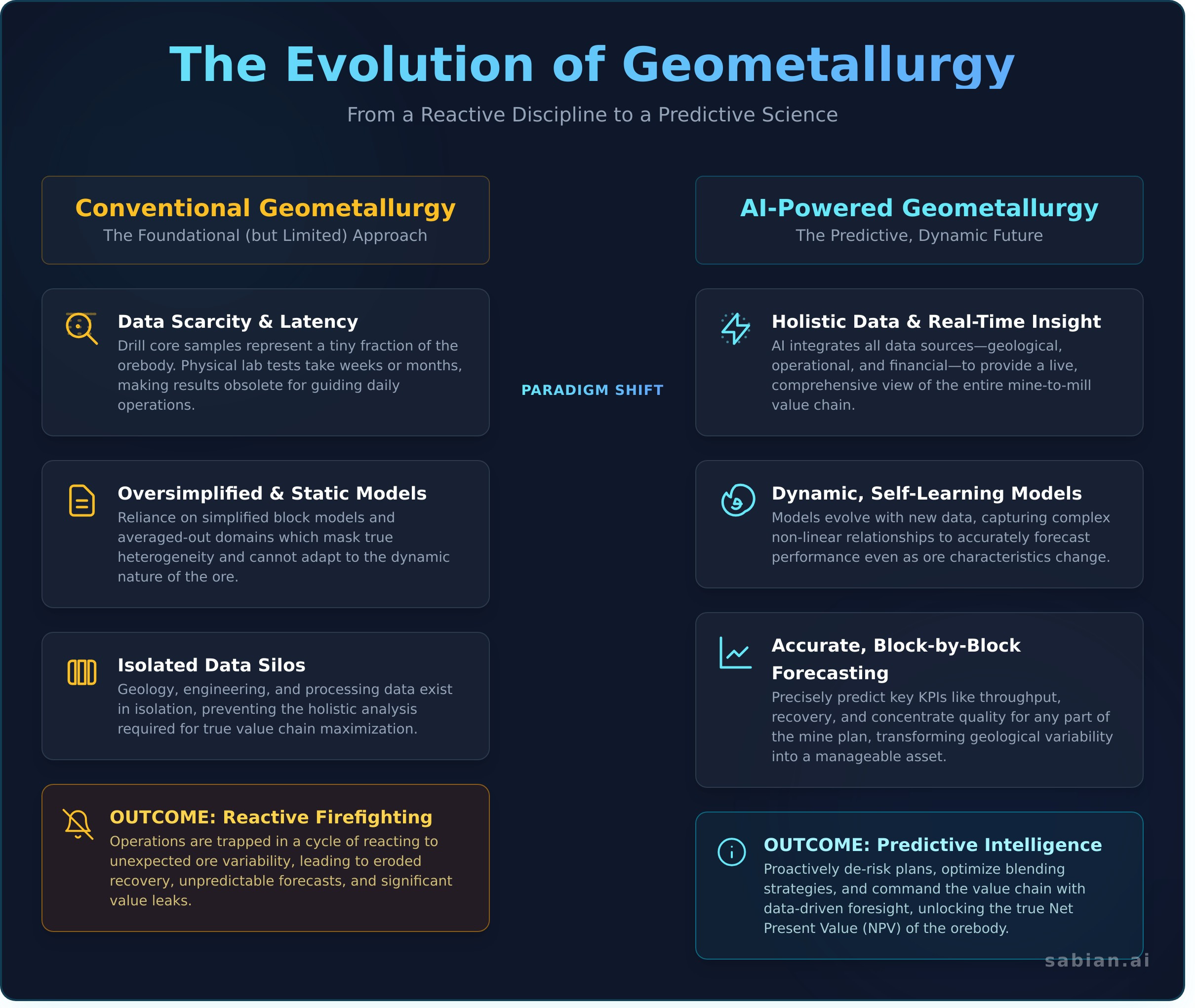
While a foundational discipline, conventional geometallurgy operates within significant constraints. Its methods are fundamentally reactive, building a picture of the orebody from sparse, historical data points. This approach creates a critical lag between geological assessment and metallurgical reality, capping the potential for proactive, real time process optimization and exposing operations to significant financial and operational risk. Data often exists in isolated silos geology, engineering, and processing preventing the holistic analysis required for true value maximization.
The Data Scarcity and Time-Lag Problem
The primary bottleneck is the data itself. Physical sampling and testing, the cornerstones of traditional analysis, are inherently slow and limited in scope. This creates a cascade of operational inefficiencies:
-
Limited Representation: Drill core samples represent an infinitesimally small fraction of the total orebody volume, offering a statistically incomplete view.
-
Operational Latency: Physical lab tests for mineralogy and metallurgical performance can take weeks or even months, rendering the results obsolete for guiding daily operational decisions.
-
Oversimplification: This forces a reliance on simplified block models and averaged-out domains, which mask the true, high-resolution heterogeneity of the ore.
-
Unforeseen Variability: Consequently, the model fails to predict localized, high-impact variability that can derail plant performance and recovery rates.
The Challenge of Complexity and Static Models
The data deficit forces a reliance on overly simplistic and static models. These frameworks struggle to capture the intricate, non-linear relationships between geological attributes and processing outcomes, a reality that highlights the Limitations of Conventional Geometallurgy as defined by industry experts. The result is a system that cannot adapt to the dynamic nature of the ore, leading to inaccurate forecasts when characteristics change unexpectedly.
This structural weakness means that simple linear regressions are incapable of accurately modeling complex mineral interactions and their synergistic effects on recovery. Because conventional models are static artifacts, updating them with new operational data is a cumbersome and infrequent process. Ultimately, operations are trapped in a cycle of reactive firefighting in the plant instead of executing proactive, data-driven optimization.
The Paradigm Shift: AI’s Role in a Predictive Geometallurgical Future
The foundational principles of geometallurgy are well established, as detailed in resources like the Global Mining Guidelines Group’s Introduction to Geometallurgy. However, their execution has been historically constrained by data scarcity and the inability of conventional systems to process immense operational complexity. Artificial intelligence represents the definitive solution to this challenge. AI driven Predictive Intelligence ingests and synthesizes vast, disparate datasets in real-time, transforming the static, historical model into a dynamic, forward-looking operational system.
This shift moves the entire value chain from a reactive posture to a predictive one, unlocking efficiencies that were previously unattainable.
From Sparse Samples to Rich Intelligence
AI platforms move beyond the limitations of physical sampling by learning the intricate, non linear relationships between all available data points. This process builds a high fidelity digital twin of the orebody’s metallurgical behavior that evolves with every new piece of information. The system ingests everything from geological assays and blast hole data to hyperspectral imaging and live plant sensor feeds, identifying how easily measured proxies directly correlate with complex process outcomes like recovery and throughput. The result is a high-resolution predictive map for every block in the mine plan.
Achieving Real-Time Optimization
This predictive capability transforms the geometallurgical model from a strategic planning document into a live, tactical tool. Instead of reacting to ore variability after it has disrupted the plant, operators can anticipate its impact with precision.
-
Proactive Control: AI models forecast the processing performance of upcoming ore feeds, enabling proactive adjustments to plant controls, reagent dosing, and grinding circuits.
-
Strategic Blending: This foresight facilitates superior ore blending and stockpiling strategies, ensuring a consistent and optimized feed that maximizes recovery.
-
Live Operational Intelligence: The model ceases to be a static document and becomes a dynamic interface for decision-making, turning operational control from a reactive discipline into a predictive science.
By leveraging AI, the promise of geometallurgy is fully realized, maximizing resource value not just in planning, but in real-time execution.
STRATA: The AI Platform for Geometallurgical Intelligence
The theoretical power of AI driven geometallurgy is made operational reality through STRATA from Sabian.ai. This platform is not a generic analytics tool; it is a purpose built intelligence engine engineered to master the extreme mineralogical and processing complexities inherent to critical minerals and Rare Earth Elements (REEs). STRATA ingests and synthesizes vast, disparate datasets from geological block models and assay results to real-time sensor readings from the plant transforming them into a single, dynamic, and high fidelity forecast of process performance. It provides the operational foresight necessary to move beyond reactive adjustments and into proactive value optimization across the entire operation.
How STRATA Revolutionizes the Geometallurgical Workflow
STRATA dismantles data silos by creating a live, unified model of the entire value chain. It integrates complex geological data with high velocity plant data streams, enabling its machine learning core to continuously learn and refine predictions as new information becomes available. The result is a single source of truth a predictive view that empowers operators and planners to anticipate challenges and capitalize on opportunities before they arise. See how STRATA delivers predictive intelligence.
Core Capabilities and Predictive Outputs
The platform’s predictive outputs are not abstract metrics; they are actionable intelligence designed to drive tangible financial and operational outcomes. By linking orebody characteristics to plant performance, STRATA delivers high fidelity forecasts that directly impact profitability.
-
Ore Block Forecasting: Predicts metallurgical recovery, final product grade, and critical impurity levels for every block before it enters the plant.
-
Comminution Performance: Forecasts circuit throughput and energy consumption (kWh/t), enabling proactive management of the most energy intensive stage of processing.
-
Reagent & Cost Optimization: Models and predicts optimal reagent dosage, minimizing waste and reducing key operational expenditures.
-
Value Chain Optimization: Delivers holistic, actionable insights to maximize net resource value from the mine face through to the final market ready product.
The Future of Resource Value is Predictive Intelligence
The era of reactive decision-making in mining is drawing to a close. While conventional frameworks have provided a crucial foundation, they inherently lack the foresight needed to navigate the escalating complexity of modern orebodies. The paradigm shift is here: leveraging artificial intelligence to transform geometallurgy from a historical analysis discipline into a dynamic, forward-looking predictive engine. This evolution is the definitive key to unlocking unprecedented resource value and operational certainty.
Sabian.ai spearheads this transformation with STRATA, the world’s first AI platform engineered for the unique challenges of rare earth and critical mineral value chains. Our system delivers the predictive intelligence required to de-risk complex operations and maximize Net Present Value from deep within the orebody. Discover the next frontier of resource optimization. Request a demonstration to see how STRATA can unlock the true value of your orebody.
The future of mining is not just automated; it is intelligent. Step into it with confidence.
Frequently Asked Questions
What kind of data is required to power an AI geometallurgy platform like STRATA?
STRATA’s predictive intelligence engine requires a synthesis of diverse data streams. This includes geological data (drill hole assays, lithology, geophysical surveys), mineralogical data (QEMSCAN, XRD), and operational data from the processing plant (sensor readings, throughput, recovery rates). The platform is designed to integrate and find correlations across these disparate datasets, transforming historical information into a powerful forward-looking tool for optimizing mine to mill performance and resource valuation.
How does AI handle the geological uncertainty and mineralogical complexity inherent in orebodies?
AI excels at identifying complex, non linear relationships that are difficult to model with traditional methods. STRATA uses advanced machine learning algorithms to map intricate mineral textures and associations to processing performance. It handles uncertainty by generating probabilistic forecasts rather than single-point estimates. This provides a clear risk profile for different ore blocks, allowing planners to anticipate and mitigate challenges related to ore variability long before the material reaches the plant.
Is AI-driven geometallurgy a replacement for experienced geologists and metallurgists?
No. AI driven geometallurgy is a powerful augmentation tool, not a replacement for human expertise. The STRATA platform automates the laborious task of multi domain data integration and analysis, providing predictive insights at a speed and scale previously unattainable. This empowers geologists and metallurgists to focus on higher value strategic work, such as validating model outputs, investigating anomalies, and making more informed, data-backed decisions to maximize resource value.
How does the STRATA platform integrate with existing mine planning software and control systems?
STRATA is engineered for seamless integration. The platform connects with standard mine planning software like Deswik, Vulcan, and Maptek via robust APIs, enriching block models with predictive metallurgical performance data. It also integrates with plant control systems (DCS/SCADA) and historians like PI System. This allows STRATA to feed optimized processing parameters directly to operations, closing the loop between resource definition and real-time plant control for a fully optimized value chain.
What is the typical implementation process and timeline for deploying STRATA?
A typical deployment follows a phased approach. The process begins with a 4-6 week data discovery and integration phase. This is followed by an 8-12 week model training and validation period, where our data scientists work with your domain experts. The final phase is deployment, user training, and system handover, which takes 2-4 weeks. A full site implementation is typically completed within 4 to 6 months, contingent on data quality and accessibility.
Can AI models be trusted, or are they an impenetrable ‘black box’?
STRATA is built on the principle of explainable AI (XAI). While the underlying algorithms are complex, the platform provides clear visualizations and feature-importance metrics that show which variables are driving the predictions. This transparency allows your domain experts to interrogate and understand the model’s reasoning, building trust and ensuring that the outputs are not only accurate but also defensible and actionable. It transforms the AI from a ‘black box’ into a trusted advisory system.