
Hi, this is a comment. To get started with moderating, editing, and deleting comments, please visit the Comments screen in…
Geopolitical Risk
in Mining: A Guide to Supply Chain Threats
Your long term projects are priced, your capital is
deployed, and your supply chain is mapped. Yet,

Your long term projects are priced, your capital is deployed, and your supply chain is mapped. Yet, a sudden export ban, a shift in regional power, or a nationalization decree thousands of miles away can render it all obsolete overnight. This is the volatile reality of geopolitical risk mining, a domain where traditional risk assessment models are increasingly falling short. The sheer velocity and complexity of global events leave even the most seasoned operators exposed to critical threats that can destabilize operations and erase value in an instant.
This guide is engineered to provide clarity in the chaos. We will deconstruct the complex threats from resource nationalism to infrastructure weaponization that define the modern mineral supply chain. More critically, we will demonstrate how AI driven predictive intelligence offers a new paradigm for security and strategic advantage. You will gain an actionable framework to anticipate disruptions, safeguard investments, and transform volatility into a competitive edge, securing your position at the forefront of the industry.
Defining Geopolitical Risk in the Mining Sector
Geopolitical risk in the mining sector transcends simple political instability. It is the complex interplay of international relations, sovereign policy shifts, and economic statecraft that directly impacts mineral supply chains. The industry’s unique structure makes it exceptionally vulnerable. Mining operations are defined by fixed, immovable assets massive capital investments locked into a specific sovereign territory. This creates a fundamental mismatch between the decades-long investment horizons required for exploration and production and the often volatile, short-term nature of political cycles.
This inherent vulnerability means that understanding and forecasting geopolitical risk mining is not an optional exercise; it is a core component of strategic planning and operational survival. As nations weaponize trade and prioritize supply chain security, the stakes have never been higher.
Why Mining is on the Geopolitical Frontline
Minerals form the bedrock of national security, economic power, and technological advancement. The global energy transition has intensified this reality, creating a fierce competition for critical materials like lithium, cobalt, and rare earth elements (REEs). The extreme geographic concentration of these reserves with cobalt dominated by the DRC and REEs by China creates strategic chokepoints. This gives resource-rich nations immense leverage, often leading to policies like export controls or the rise of resource nationalism as governments seek to maximize their control and economic benefit.
The Spectrum of Risk: From ‘Above Ground’ to ‘Below Ground’
Historically, mining risk was dominated by ‘below ground’ factors: the geological uncertainty of discovering and extracting a viable ore body. Today, the primary threat is often ‘above-ground’ risk. This category encompasses the entire political, social, and regulatory landscape from sudden tax hikes and asset expropriation to sanctions and civil unrest. In the modern landscape of geopolitical risk mining, these ‘above ground’ challenges frequently outweigh the technical and geological hurdles, making advanced political intelligence an indispensable tool for navigating the sector.
The Four Core Categories of Geopolitical Risk for Miners
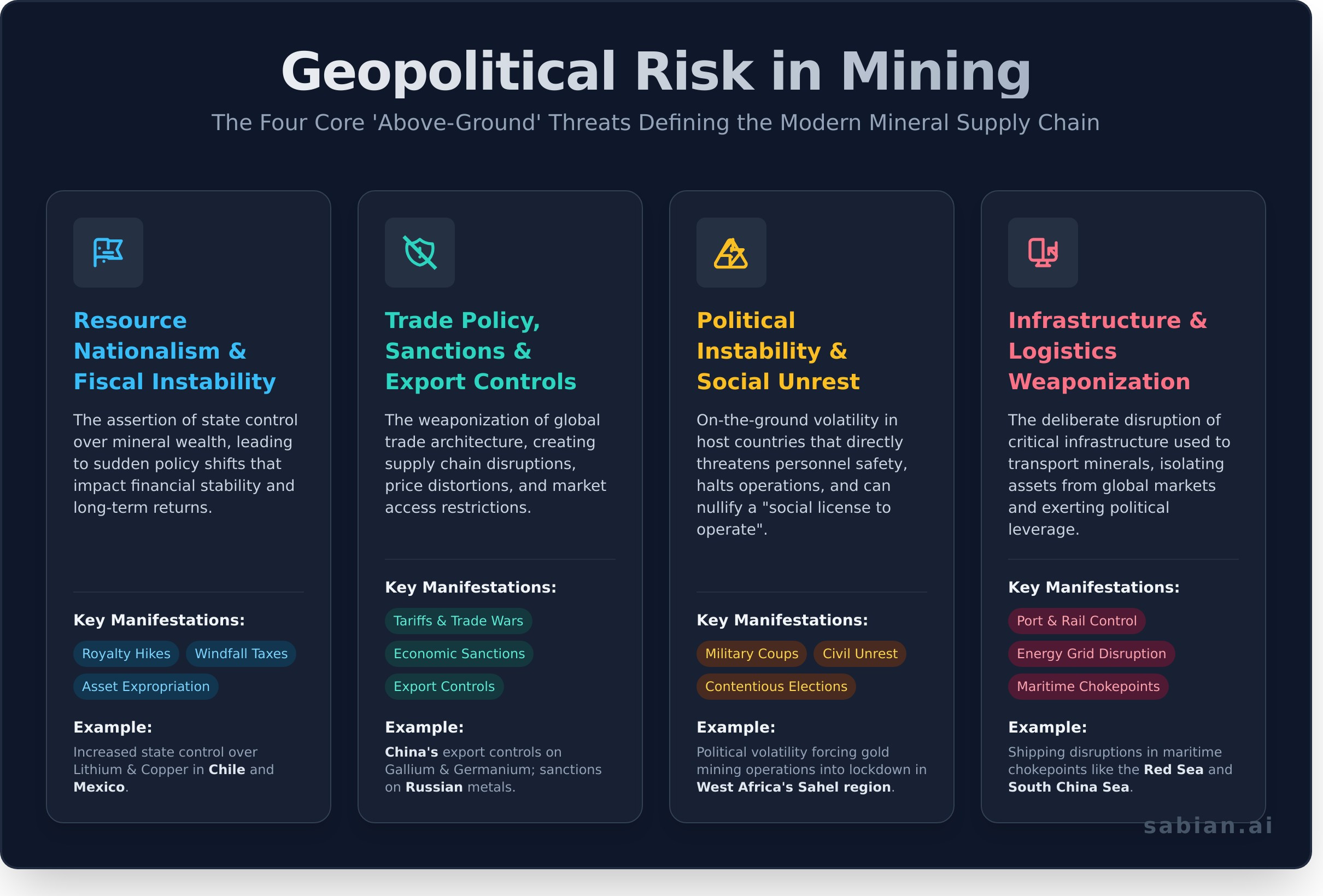
To navigate the complex landscape of geopolitical risk mining, operators and investors require a structured framework. The abstract threat of "geopolitics" can be deconstructed into four distinct, yet interconnected, categories of risk. Understanding these vectors is fundamental to developing predictive intelligence and safeguarding critical mineral supply chains.
Resource Nationalism and Fiscal Instability
Resource nationalism is the assertion of state control over mineral wealth within its borders. This can manifest suddenly and with significant financial impact through mechanisms like royalty hikes, windfall profit taxes, or forced contract renegotiations. In its most extreme form, it leads to the expropriation of assets. Recent moves in Latin America, where governments in Chile and Mexico are increasing state control and taxation over strategic lithium and copper resources, exemplify this direct threat to operational stability and long-term investment returns.
Trade Policy, Sanctions, and Export Controls
Global trade architecture is a primary vector for geopolitical risk. Trade wars introduce tariffs that disrupt mineral flows and distort market prices. More acutely, sanctions targeting nations like Russia directly impact the global supply of key industrial metals, including nickel and aluminum. Furthermore, the strategic use of export controls such as China’s restrictions on gallium and germanium demonstrates how a dominant producer can weaponize its supply chain position, creating immediate and severe shortages for downstream high-tech industries.
Political Instability and Social Unrest
On-the-ground stability in a host country is paramount. Risks in this category range from military coups and civil unrest to contentious elections that can upend the regulatory environment overnight. These events directly threaten personnel safety and can halt operations for indefinite periods. A breakdown in community relations, leading to the loss of a "social license to operate," can be equally disruptive. As seen in West Africa’s Sahel region, political volatility has repeatedly forced gold mining operations into lockdown, highlighting why sophisticated legal and insurance frameworks are required to mitigate political risks before they cascade.
Infrastructure and Logistics Weaponization
A mine’s output is only valuable if it can reach the global market. This category of geopolitical risk mining involves the deliberate disruption of critical infrastructure. State and non-state actors can exert political leverage by targeting or controlling essential logistics, including:
-
Ports and shipping terminals
-
Railway lines and transport corridors
-
Energy grids supplying power to operations
Disruptions in maritime chokepoints like the Red Sea or the South China Sea serve as a potent reminder that even a highly efficient mine can be isolated from its customers by events occurring thousands of miles away.
Translating Risk into Business Impact: From Mine Site to Market
Geopolitical events are not abstract concepts; they are direct inputs into financial models and operational plans. Understanding how a political shift in a single jurisdiction translates into quantifiable business impact is the central challenge in managing geopolitical risk mining. The consequences ripple from the mine’s balance sheet to global commodity markets and downstream manufacturers, manifesting in three critical areas.
Extreme Price Volatility and Market Shocks
A sudden export ban on a critical mineral or a prolonged labor strike can trigger immediate, violent price spikes on commodity exchanges. This is not just short-term turbulence; persistent uncertainty embeds a higher risk premium into futures contracts. This volatility renders traditional hedging strategies unreliable and complicates long-term offtake agreements, impacting the financial stability of mining operators and creating profound cost uncertainty for end-users in the EV, aerospace, and defense sectors.
Project Delays and Capital Expenditure Blowouts
Political instability directly threatens the project pipeline. A newly elected government can freeze permitting processes, impose windfall taxes, or demand greater state ownership, instantly altering a project’s economic viability and net present value (NPV). This leads to massive capital expenditure (CapEx) overruns and indefinite delays. Consequently, investors become risk-averse, starving promising assets in high-risk jurisdictions of essential funding and severely constraining future supply growth for minerals vital to the energy transition.
Supply Chain Fragmentation and Security Threats
The era of hyper efficient, just in time global supply chains is fracturing. Nations are now prioritizing security over pure efficiency, leading to the rise of regional supply blocs and ‘friend-shoring’ initiatives. While this strategy builds redundancy, it introduces significant costs and logistical complexity. For downstream manufacturers, the critical challenge becomes mapping these fragmented networks to ensure sourcing resilience. The opaque nature of these emerging supply chains is a primary operational threat derived from geopolitical risk mining, demanding a new level of predictive intelligence to maintain visibility and control.
Mitigation Strategies: From Traditional Buffers to Predictive Intelligence
Navigating the complex landscape of geopolitical risk in mining requires a strategic evolution from passive defense to active, predictive intelligence. While traditional risk management techniques have provided a foundational safety net, their limitations in a hyper-connected, volatile world are becoming increasingly apparent. The future of supply chain security lies in anticipating disruption, not merely reacting to it.
Legacy Approach: Insurance and Diversification
Historically, operators have relied on two primary buffers: Political Risk Insurance (PRI) and geographic diversification. PRI offers financial compensation for losses stemming from events like expropriation, political violence, or currency inconvertibility. Diversification aims to spread operational assets across different political jurisdictions to avoid over-exposure to a single point of failure. However, these methods are fundamentally reactive. PRI is an expensive backstop that pays out after a crisis has already occurred, and true diversification is often impossible for critical minerals like cobalt or rare earths, which are overwhelmingly concentrated in a few high-risk regions.
Modern Approach: The Rise of Predictive Analytics
A paradigm shift is underway, powered by artificial intelligence and machine learning. This modern approach leverages predictive analytics to move from reaction to anticipation. AI systems can ingest and analyze massive, unstructured datasets in real-time from local news reports and social media sentiment to satellite imagery and complex policy papers. By identifying subtle patterns and precursor signals that are invisible to human analysts, these platforms can forecast instability, labor strikes, or policy shifts weeks or months in advance, transforming the management of geopolitical risk mining from a defensive posture to a strategic advantage.
Building a Resilient Supply Chain with AI
True supply chain resilience is the ability to anticipate, absorb, and adapt to disruptions with minimal impact. AI powered platforms enable this by running sophisticated simulations on supply networks. These models can project the cascading effects of a potential port closure, a new export tariff, or a sudden change in regime, allowing organizations to stress-test their operations and develop data-driven contingency plans. This foresight transforms abstract risks into quantifiable scenarios, enabling proactive alternative sourcing and logistical adjustments before a crisis materializes. See how AI delivers predictive intelligence for critical minerals.
Beyond Reaction: Mastering Geopolitical Risk with Predictive Intelligence
The global mining sector operates on a knife’s edge of geopolitical uncertainty. As detailed, identifying the core categories of risk from resource nationalism to infrastructure vulnerability is the foundational step. However, in an increasingly volatile world, traditional mitigation strategies are merely reactive, leaving supply chains exposed. True resilience in the face of geopolitical risk mining requires a fundamental evolution: a shift from anticipating impact to predicting intent. This proactive stance is no longer an advantage; it is an operational necessity.
This is the new frontier of operational security. Sabian.ai delivers this capability as the world’s first AI platform for critical minerals. Our system is engineered to deliver true predictive intelligence for mining operations, transforming disconnected data points into strategic foresight. By anticipating instability, you can secure assets, protect investments, and ensure supply chain integrity with unparalleled confidence.
Harness Predictive Intelligence to Secure Your Supply Chain. The future belongs to those who can see it coming. Lead the transformation from risk to resilience.
Frequently Asked Questions
What is a primary example of geopolitical risk in the mining industry?
Resource nationalism is a critical example. This occurs when a host country asserts control over its natural resources, often through expropriation, sudden tax hikes, or export restrictions on foreign-owned mining operations. For instance, shifts in mining codes in countries like Chile or the DRC can instantly devalue assets and disrupt global supply chains for crucial materials like lithium and cobalt, creating significant financial and operational threats for international mining companies.
How do companies measure or quantify geopolitical risk for an investment?
Quantifying geopolitical risk requires a multi-faceted data approach. Companies utilize country risk indices, which score factors like political stability, regulatory quality, and sanction exposure. Advanced analysis, often powered by AI, integrates real time data streams from policy announcements to satellite imagery to model potential disruption scenarios. This predictive intelligence allows investors to assign a quantitative risk value to an asset, enabling more strategic capital allocation in volatile regions.
Which critical minerals are most exposed to geopolitical risk today?
Minerals with highly concentrated supply chains face the most acute geopolitical risk. Rare Earth Elements (REEs), with over 85% of processing dominated by China, are a prime example. Similarly, cobalt is heavily exposed due to the Democratic Republic of Congo’s market dominance. Lithium from South America’s "Lithium Triangle" and nickel from Indonesia also present significant supply vulnerabilities, as any regional instability or policy shift can create global shortages for key technologies.
How does China’s dominance in rare earth elements constitute a geopolitical risk?
China’s control over the processing of Rare Earth Elements (REEs) creates a potent geopolitical lever. This dominance enables the potential for supply chain weaponization, where export quotas or outright bans can be used to achieve political objectives. Given that REEs are indispensable for advanced defense systems and electric vehicles, this concentration represents a critical vulnerability for Western economies. It effectively grants a single state immense influence over global high-technology and security sectors.
What is the difference between geopolitical risk and political risk?
Political risk is localized, concerning instability within a single country’s borders such as coups, regulatory changes, or civil unrest. Geopolitical risk is broader, involving the interplay between multiple international actors. It encompasses threats like sanctions, trade wars, or regional conflicts that transcend national boundaries. Understanding both is essential for assessing geopolitical risk mining operations, as a mine faces political risk from its host country and geopolitical risk from a trade dispute impacting it.
Can AI truly predict a political event like a coup or an export ban?
AI does not predict events with absolute certainty, but it provides powerful predictive intelligence. By analyzing massive, unstructured datasets including satellite imagery, social media sentiment, and obscure policy documents AI models can identify precursor signals and patterns invisible to human analysts. This allows for the high-probability forecasting of destabilizing events like coups or export bans. It transforms risk management from a reactive to a proactive discipline, enabling companies to anticipate and mitigate threats.