
Hi, this is a comment. To get started with moderating, editing, and deleting comments, please visit the Comments screen in…
Optimizing Solvent
Extraction Electrowinning (SX-EW) with AI Process Control
Reactive process control is obsolete. In modern hydrometallurgy, the
persistent struggle with unstable chemistry, costly crud formation,

Reactive process control is obsolete. In modern hydrometallurgy, the persistent struggle with unstable chemistry, costly crud formation, and inconsistent cathode purity represents a critical failure of foresight. These challenges are not inevitable costs of business; they are data points signaling the need for a more intelligent operational paradigm. For operators of solvent extraction electrowinning circuits, the reliance on lagging indicators means accepting preventable losses in metal recovery and plant uptime. The future, however, is predictive, not reactive.
This authoritative guide details the transition to AI driven predictive control. We dissect the core operational vulnerabilities of the SX-EW process and reveal how intelligent systems are achieving unprecedented stability and efficiency. Discover the practical steps to implement AI, prevent costly disruptions before they manifest, and unlock new levels of metal recovery. This is the blueprint for optimizing your circuit with predictive intelligence.
Fundamentals of the Solvent Extraction & Electrowinning (SX-EW) Circuit
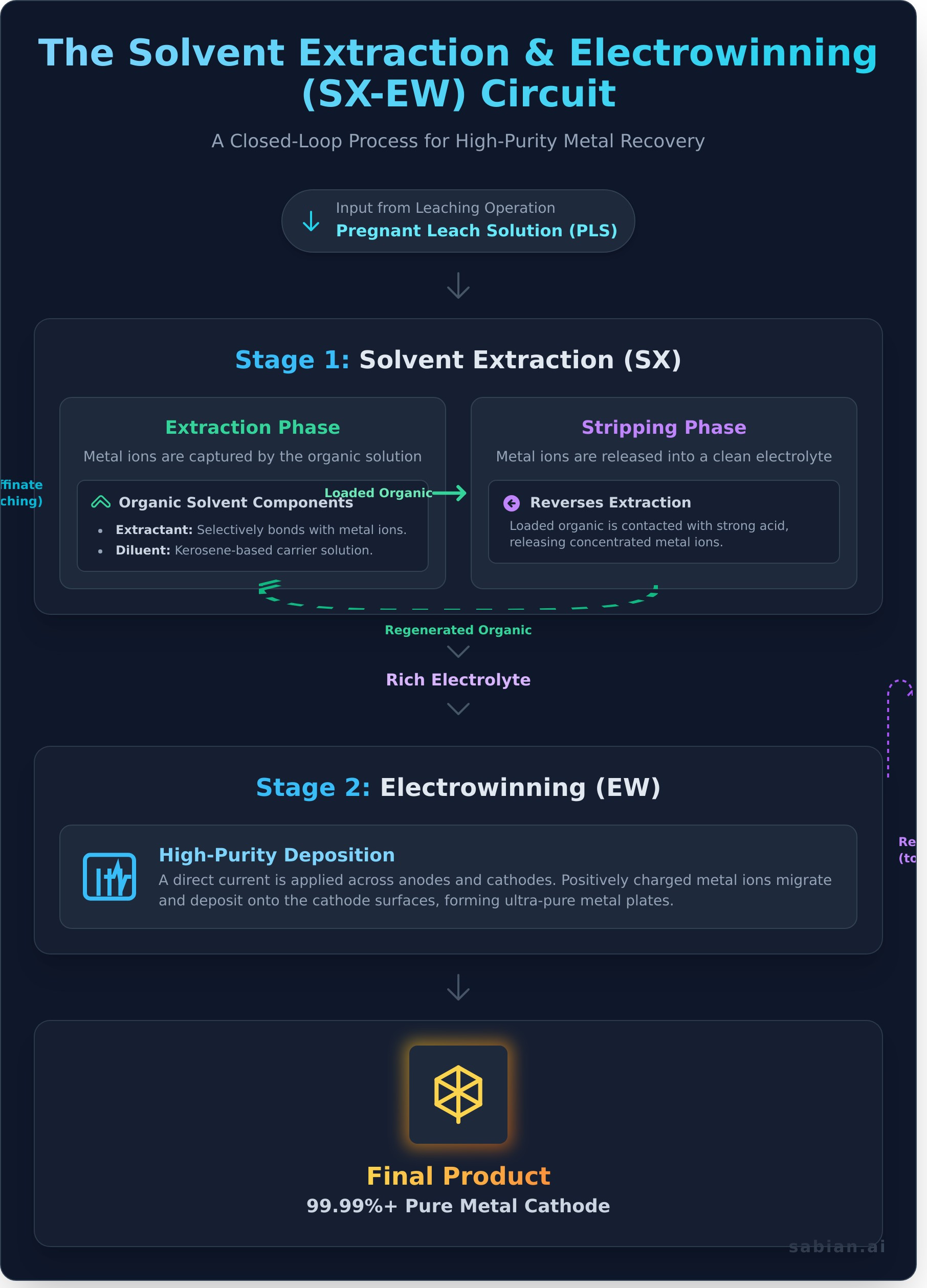
The solvent extraction electrowinning (SX-EW) process is a core hydrometallurgical technology engineered for the recovery of exceptionally pure metals from low grade ores and solutions. Historically the domain of high purity copper production, its application is rapidly expanding to meet the global demand for critical minerals, including cobalt and nickel, which are essential for advanced battery and energy technologies. The power of SX-EW lies in its elegant, closed loop design, which systematically isolates and concentrates target metals. The fundamentals of Solvent Extraction & Electrowinning outline a two stage circuit that transforms a dilute, impure solution into a final, high-grade metal cathode, ready for market.
This integrated circuit operates through two distinct but interconnected stages: the selective separation and concentration of metal ions in the Solvent Extraction (SX) plant, followed by high purity electrochemical deposition in the Electrowinning (EW) tank-house.
Stage 1: Solvent Extraction (SX) – The Separation and Concentration Engine
The SX circuit acts as the system’s highly selective chemical engine. It begins with the Pregnant Leach Solution (PLS), a dilute, metal-rich aqueous solution generated from heap, dump, or in-situ leaching operations. This PLS is intimately mixed with a specialized organic solvent in the Extraction phase. The organic solution contains key reagents:
-
Extractant: An active organic compound designed to chemically bond with and selectively sequester the target metal ions from the PLS.
-
Diluent: A carrier, typically a high-flashpoint kerosene, that dissolves the extractant and ensures proper phase disengagement.
Once the metal ions are loaded onto the organic phase, the now barren aqueous solution (raffinate) is recycled back to the leaching stage. The loaded organic then enters the Stripping phase, where it is contacted with a strong acid. This reverses the extraction reaction, moving the concentrated metal ions into a clean, high strength electrolyte solution and regenerating the organic solvent for reuse.
Stage 2: Electrowinning (EW) – Plating the Final Product
The rich electrolyte from the SX stripping stage becomes the feedstock for the Electrowinning (EW) tank-house. Here, the process of high purity deposition occurs through electrolysis. A direct current is applied across a series of anodes and cathodes submerged in the electrolyte. This electrical potential drives a precise electrochemical reaction: the positively charged metal ions migrate and deposit onto the cathode surfaces, forming layers of 99.99%+ pure metal. Simultaneously, the anodes facilitate the breakdown of water, regenerating the acid that is then returned to the SX stripping circuit, completing the closed loop. Precise control over variables like current density, electrolyte temperature, and chemical composition is critical to producing high-quality cathodes and maximizing operational efficiency.
Critical Operational Challenges in Conventional SX-EW Plants
The solvent extraction electrowinning process is a complex, large scale hydrometallurgical circuit where minor operational deviations can cascade into significant financial and production losses. Conventional process control, typically managed by PLC/SCADA systems, operates on a reactive basis. It corrects deviations after they occur, failing to anticipate the dynamic interplay of chemical and physical variables. This inherent latency creates a persistent state of suboptimal performance and exposes the operation to substantial risk.
Chemical Instability and Reagent Management
The organic reagents central to SX-EW represent a major operational cost. Their effectiveness is highly sensitive to degradation and precise dosing. Maintaining optimal pH and concentration levels is a constant battle against fluctuating feed compositions. Furthermore, contaminants in the pregnant leach solution (PLS) such as silica, manganese, or chlorides can "poison" the organic phase, drastically reducing its extraction capability and lifespan. Suboptimal reagent dosing directly translates to wasted resources and incomplete metal extraction, eroding plant profitability.
Physical Disruptions: Crud Formation and Phase Entrainment
Physical instability manifests in two primary forms: crud and entrainment. ‘Crud’ is a stable emulsion of organic, aqueous, and solid particulates that accumulates at the phase interface, leading to severe operational problems:
-
Clogged settlers and piping, requiring costly plant shutdowns for manual cleaning.
-
Significant loss of expensive organic solvent trapped within the crud matrix.
-
Reduced processing capacity and circuit efficiency.
Phase entrainment the carryover of organic droplets into the aqueous electrolyte or vice versa is equally damaging. Organic contaminants in the electrowinning tankhouse can cause "cathode burn," while aqueous entrainment dilutes the organic phase. These Operational Challenges in Conventional SX-EW are often triggered by fine solids, surfactants from upstream processes, or improper mixing energy, creating persistent disruptions that standard controls cannot predict or prevent.
Process Inefficiencies and Value Leakage
Ultimately, chemical and physical instabilities culminate in systemic inefficiency and value leakage. Poor metal recovery rates are the most direct consequence, leaving valuable product uncaptured. Downstream, impurities carried over into the electrolyte result in lower-quality cathodes, attracting penalties and damaging market reputation. The entire solvent extraction electrowinning circuit often consumes excessive energy to compensate for these inefficiencies, particularly in the tank-house. Each of these issues represents a significant, often unquantified, loss of revenue and a failure to achieve the plant’s maximum engineered potential.
The AI Revolution: Predictive Intelligence for SX-EW Optimization
Traditional process control in solvent extraction electrowinning operates on hindsight. Operators react to alarms and deviations after they occur, leading to cyclical instability and lost efficiency. AI driven Predictive Intelligence fundamentally inverts this model, shifting operations from a reactive stance to proactive, predictive control. By continuously analyzing vast streams of existing sensor data, AI builds a dynamic digital twin of the circuit, modeling the complex, non linear chemical interactions that static systems cannot capture. This empowers operators with foresight, forecasting future process states and prescribing precise actions to maintain optimal performance before deviations ever happen.
Stabilizing Circuit Chemistry with Predictive Models
An AI model ingests real-time data including flow rates, pH, temperature, and online assays to understand the intricate dynamics of the hydrometallurgy process for copper ores. It then prescribes optimal reagent dosage rates dynamically, preventing both under dosing, which leads to poor metal recovery, and costly over-dosing. Furthermore, AI can deploy soft sensors to predict key values not measured in real time, such as metal loading on the organic phase, providing a complete, forward-looking view of circuit chemistry.
Proactive Anomaly Detection: Preventing Crud and Entrainment
Crud formation and phase entrainment are persistent threats to circuit stability and metal recovery. AI algorithms excel at identifying the subtle precursor conditions often invisible to the human eye or standard alarms that lead to these costly events. The system can alert operators hours or even days in advance, providing a critical window to take preventative action. Recommended actions may include:
-
Adjusting mixer speed to optimize droplet size
-
Modifying phase continuity
-
Altering flow rates to stabilize the interface
This predictive capability transforms plant maintenance from a reactive chore to a strategic, data-driven function. See how Sabian’s STRATA platform provides predictive alerts for process stability.
Optimizing the Electrowinning Tankhouse
The final stage of the solvent extraction electrowinning process presents a complex optimization challenge. AI continuously analyzes the incoming pregnant leach solution (PLS) composition to recommend the ideal current density. This strikes a precise balance between maximizing production rate, ensuring high purity cathode quality, and minimizing energy consumption, a major operational cost. The system can also predict and help prevent physical issues like electrode shorts or anode passivation, ensuring the tankhouse operates at peak electrical and metallurgical efficiency.
Implementing an AI-Driven Strategy for Your SX-EW Circuit
Deploying artificial intelligence is not about replacing your existing infrastructure; it is a strategic enhancement of modern process control. The goal is to transform your accumulated operational data into a predictive, high performance asset. This implementation leverages your current systems to unlock a new tier of efficiency and precision in your solvent extraction electrowinning operations.
The path to an AI optimized circuit is a structured, three-stage process designed for maximum impact and seamless integration.
Step 1: Data Aggregation and Contextualization
Effective AI begins with high-fidelity data. We integrate disparate data streams including SCADA, LIMS, process historians, and IoT sensor outputs into a unified data architecture. This raw data undergoes rigorous cleaning and contextualization, creating a holistic digital record where every variable, from ore feed characteristics to final cathode quality, is interconnected. This foundational step ensures the reliability of all subsequent predictive models.
Step 2: Developing the Digital Twin and Predictive Models
A digital twin is a dynamic, virtual replica of your physical hydrometallurgical plant. Using your contextualized historical data, our machine learning algorithms are trained to understand the complex, non-linear relationships within your circuit. This model is then rigorously validated against real-world outcomes to certify its predictive accuracy, ensuring it can precisely forecast process behavior under variable conditions.
Step 3: Deploying Actionable Intelligence
The digital twin translates complex predictions into clear, actionable intelligence. Operators receive prescriptive recommendations such as optimal reagent dosage or electrowinning current density via intuitive dashboards. This elevates decision making from reactive to predictive. The ultimate objective is full integration with your existing control systems, enabling closed-loop optimization that autonomously adjusts setpoints to maximize throughput and minimize costs in the solvent extraction electrowinning process.
Transform your operational data into your most powerful strategic asset. Request a demo to see how our predictive intelligence platform integrates with your operations.
The Predictive Frontier of Hydrometallurgical Processing
The era of reactive management in mineral processing is ending. As we’ve explored, conventional operational challenges from reagent consumption to cathode quality have long constrained the efficiency of the solvent extraction electrowinning circuit. The integration of artificial intelligence fundamentally shifts this paradigm, moving operations from a state of response to one of predictive foresight. By leveraging AI, producers can anticipate process deviations, optimize inputs in real-time, and stabilize the entire hydrometallurgical circuit for unprecedented gains in productivity and profitability.
The path forward is clear. It’s time to transform your operational data into predictive foresight and actionable value. Sabian AI, powered by the STRATA predictive intelligence platform, is engineered for the unique demands of critical minerals and complex metallurgy. Achieve Predictive Control of Your Hydrometallurgical Circuit with Sabian AI and redefine the performance ceiling of your operation.
Embrace the predictive revolution. The future of your circuit is not just automated; it is intelligent.
Frequently Asked Questions
What is the difference between standard process automation (PLC/SCADA) and AI-driven optimization for SX-EW?
Standard automation like PLC/SCADA operates on fixed rules, reacting to deviations from pre-set parameters to maintain stability. AI driven process control is predictive and holistic. It models the complex, non-linear interactions within the circuit, continuously adjusting multiple variables such as reagent dosage and flow rates, to achieve superior efficiency and recovery rates. AI moves beyond simple stabilization to true performance maximization, making intelligent decisions rather than just executing commands.
How does an AI system account for variability in ore feed grade and composition entering the SX-EW plant?
An AI system ingests continuous data from upstream sensors, including ore grade analyzers and mineralogy reports, to build a dynamic model that predicts how feed variability will impact circuit performance. By understanding these relationships, the AI can proactively adjust key operating parameters in real-time. This anticipatory control mitigates the effects of fluctuating feed, stabilizing and optimizing the entire solvent extraction electrowinning process for consistent, high-purity cathode production.
Can AI help reduce the environmental footprint of solvent extraction and electrowinning?
Absolutely. AI-driven optimization directly targets resource efficiency, which is fundamental to reducing environmental impact. The system minimizes the consumption of reagents, such as extractants and acids, by precisely dosing what is required, reducing chemical waste. Furthermore, by optimizing current density and cellhouse conditions in the electrowinning stage, the AI significantly lowers electricity consumption. This leads to a measurable reduction in both operational costs and the overall carbon footprint of the operation.
What is the typical ROI for implementing an AI process control system on an SX-EW circuit?
The return on investment for an AI process control system is typically realized within 6 to 12 months. Primary financial gains are driven by a 1-3% increase in copper recovery, a 5-15% reduction in reagent consumption, and significant energy savings in the electrowinning cells. These direct operational savings, combined with improved cathode quality and process stability, create a compelling and rapid payback period for most SX-EW operations, delivering substantial long-term value.
Is AI optimization applicable to smaller-scale operations or only for major copper producers?
AI optimization delivers significant value to operations of all scales. While major producers benefit from incremental gains across vast production volumes, smaller-scale plants often see a more profound impact on their unit costs and overall profitability. The scalability of modern AI platforms makes advanced process control accessible and financially viable for any producer aiming to maximize the efficiency of their solvent extraction electrowinning circuit, regardless of size.
How does Sabian’s STRATA platform specifically address the challenge of crud formation in SX circuits?
Sabian Global Inc, STRATA platform utilizes Predictive Intelligence to mitigate crud formation. It continuously analyzes upstream data including feed solids, entrainment levels, and chemical parameters to identify the precise conditions that lead to crud events. By recognizing these precursor patterns, STRATA provides early warnings and recommends proactive adjustments to operational setpoints. This preemptive control strategy minimizes crud buildup, reducing organic losses, preserving circuit efficiency, and decreasing costly manual interventions.