
Hi, this is a comment. To get started with moderating, editing, and deleting comments, please visit the Comments screen in…
AI in
Mining: The Definitive Guide to a New Era of Operations
The mining industry stands at a critical juncture, defined
by escalating operational complexities, persistent safety risks, and
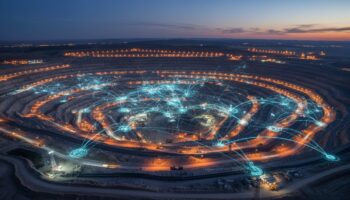
The mining industry stands at a critical juncture, defined by escalating operational complexities, persistent safety risks, and the urgent mandate for enhanced ESG performance. For many leaders, the discourse around Artificial Intelligence is clouded by hype, making the path to tangible ROI and strategic implementation unclear. This hesitation is a significant barrier to progress in an industry where efficiency and foresight are paramount. The strategic deployment of AI in mining is no longer a futuristic concept; it is the definitive operational imperative for securing a competitive advantage.
This guide is engineered to cut through the ambiguity. We provide a comprehensive framework for action, detailing how Predictive Intelligence is revolutionizing the entire value chain from uncovering new deposits and optimizing extraction to preempting equipment failure and transforming site safety. Here, you will find the specific use cases, a clear roadmap for adoption, and the intelligence required to build a more profitable, sustainable, and resilient mining operation. Welcome to the new era.
The AI Revolution in Mining: Beyond Automation to Predictive Intelligence
The mining sector is at a critical inflection point. The long established era of mechanization is giving way to a new paradigm defined by cognitive capability: Predictive Intelligence. This evolution of AI in mining moves beyond executing repetitive tasks to anticipating outcomes, optimizing complex systems in real-time, and unlocking value from previously untapped resources. In this new landscape, geological and operational data becomes the most valuable asset the new ore and artificial intelligence is the critical extraction technology.
What is AI in Mining? A Practical Definition
At its core, artificial intelligence in this context refers to systems designed to sense, comprehend, act, and learn from vast, complex datasets. While traditional Automation in Mining excels at executing pre-programmed commands for machinery, AI introduces a layer of dynamic decision-making. It processes unstructured data such as seismic surveys, drone imagery, and real-time sensor feeds that conventional analytics cannot handle. The application of AI is not monolithic; it comprises several key technologies:
-
Machine Learning (ML): Algorithms that identify patterns in historical data to forecast equipment failure or optimize drill and blast cycles.
-
Deep Learning (DL): Advanced neural networks that analyze complex geological imagery to pinpoint high-potential exploration targets with greater precision.
-
Generative AI: Emerging models capable of simulating subsurface deposit formations or generating novel, hyper-efficient mine plans.
The Business Imperative: Why Mining is Ripe for AI Disruption
The convergence of several powerful industry pressures makes the adoption of AI not just an opportunity, but a strategic necessity. The sector faces a perfect storm of challenges that demand a fundamental shift in operational intelligence. Key drivers for this disruption include:
-
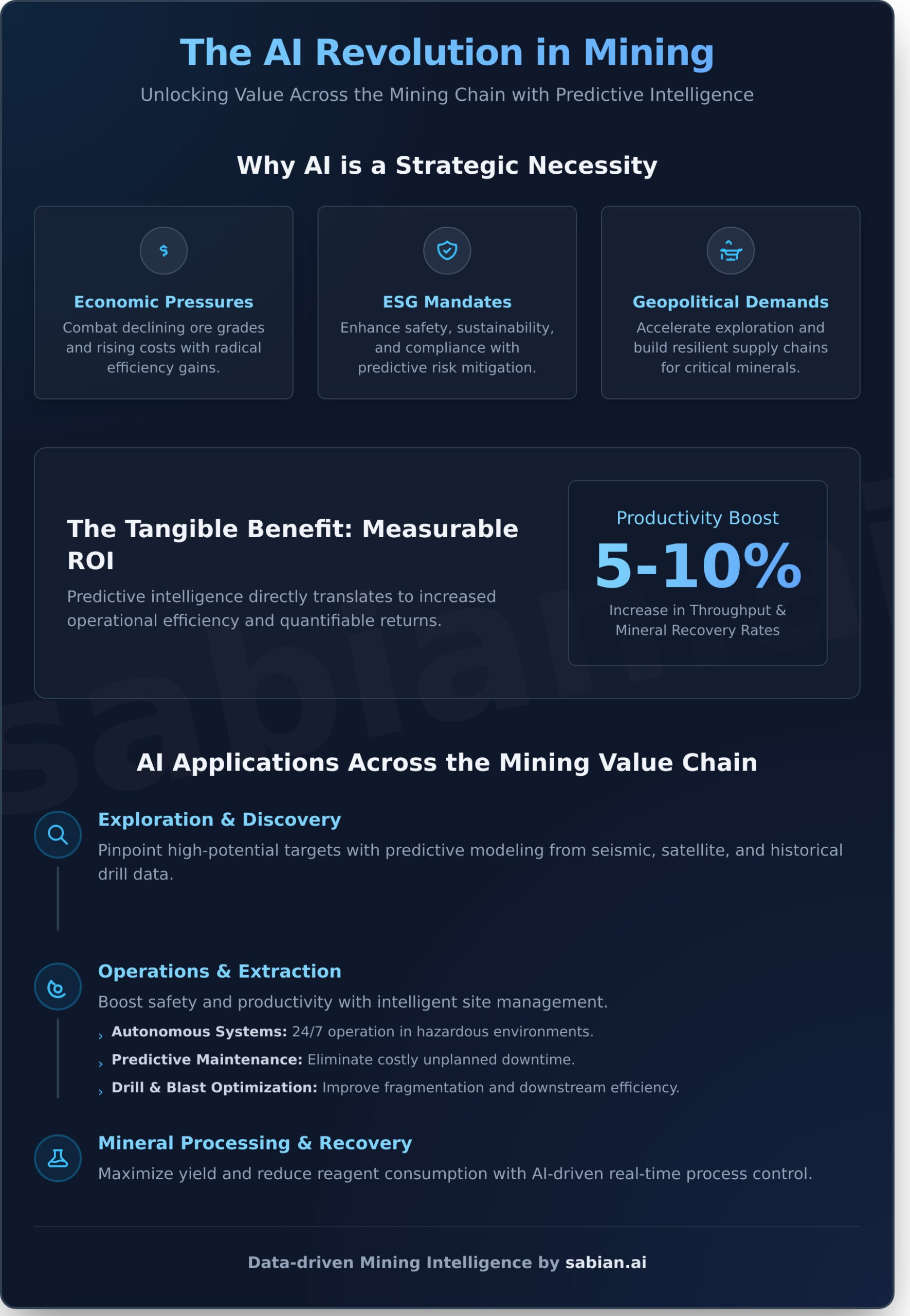
Economic Pressures: Persistently declining ore grades and escalating operational costs require radical efficiency gains that only intelligent systems can deliver.
-
ESG Mandates: Heightened demands for safety, sustainability, and environmental compliance necessitate predictive tools for risk mitigation and resource management.
-
Geopolitical Demands: The global race for critical minerals requires accelerated exploration and resilient supply chains, a challenge perfectly suited for AI-driven discovery and logistics optimization.
AI Applications Across the Entire Mining Value Chain
The integration of AI in mining is not a siloed improvement but a systemic transformation impacting every operational phase, from initial geological assessment to final market delivery. Predictive intelligence and machine learning are creating a connected, optimized ecosystem where data-driven decisions replace historical guesswork. Leading operators are now deploying AI across the mining value chain to unlock new efficiencies, enhance safety protocols, and maximize the value of every extracted ton.
Exploration and Discovery: Uncovering Deposits with Precision
In the high-stakes world of mineral exploration, AI acts as a powerful analytical engine. Machine learning algorithms process massive, multi-layered datasets including seismic surveys, satellite imagery, and historical drill logs to identify complex patterns invisible to the human eye. This enables predictive modeling that pinpoints high potential drilling targets with unprecedented accuracy, dramatically reducing the time and capital expenditure required for greenfield and brownfield discovery.
Operations and Extraction: Optimizing the Core Process
At the mine site, AI directly translates into enhanced safety and productivity. The technology underpins the most critical operational functions, driving tangible improvements in key performance indicators. Core applications include:
-
Autonomous Systems: AI-powered haulage trucks and drilling rigs operate 24/7 with superior precision, removing personnel from hazardous environments and increasing operational tempo.
-
Predictive Maintenance: Sensors on critical equipment feed data to AI models that forecast component failures before they occur, converting costly unplanned downtime into scheduled maintenance and maximizing asset uptime.
-
Drill and Blast Optimization: AI analyzes geological data to design optimal drill and blast patterns, ensuring superior rock fragmentation. This improves loader and crusher efficiency downstream.
Mineral Processing and Recovery: Maximizing Yield with Smart Chemistry
Downstream from the pit, AI optimizes the complex chemistry of mineral processing. In plants, AI driven process control systems monitor thousands of variables in real time to stabilize grinders, flotation cells, and leach circuits. By dynamically adjusting parameters like reagent dosage and airflow based on fluctuating ore characteristics, these systems ensure the process remains at peak efficiency. The result is a direct and measurable increase in mineral recovery rates, reduced consumption of expensive reagents, and a higher-quality final concentrate.
The Tangible Benefits: How AI Delivers Measurable ROI
The implementation of artificial intelligence is no longer a theoretical exercise; it is a strategic imperative that delivers quantifiable returns. For operators in the critical minerals sector, the value of AI in mining is realized across three core pillars: operational productivity, personnel safety, and environmental sustainability. These are not siloed improvements but a connected system of benefits that creates a formidable competitive advantage, transforming operational data into decisive, value driven action.
Boosting Productivity and Asset Utilization
Predictive intelligence directly translates to increased operational efficiency. By analyzing vast datasets from sensors and machinery, AI models optimize processing circuits, leading to documented improvements in throughput and mineral recovery rates of 5-10%. As detailed by industry reports on AI powered automation in mining, these systems enable a shift from reactive repairs to predictive maintenance. This foresight minimizes unplanned equipment downtime, optimizes production schedules, and ensures every asset is utilized to its maximum potential, directly impacting the bottom line.
Enhancing Worker Safety and Mitigating Risk
In an industry where risk is inherent, AI serves as a vigilant guardian. It fundamentally redesigns safety protocols by moving from lagging indicators to proactive risk mitigation. Key applications include:
-
Geotechnical Stability: AI powered monitoring systems continuously analyze seismic data and ground-penetrating radar to predict and alert teams to potential wall failures or ground instability before they become catastrophic.
-
Collision Avoidance: Advanced computer vision and sensor fusion equip heavy machinery with systems that can detect personnel and other vehicles, preventing accidents in complex, low-visibility environments.
-
Equipment Integrity: Predictive analytics monitor the health of critical equipment, identifying stress fractures or component wear to prevent failures that could endanger operators.
Driving ESG Goals and Sustainable Mining
Modern mining operations are measured not just by output but by their environmental and social performance. The application of AI in mining provides the precision required to meet and exceed ESG (Environmental, Social, and Governance) mandates. AI algorithms optimize energy and water consumption in real-time, reduce the carbon footprint of operations, and enable the intelligent sorting and reprocessing of tailings. This transforms waste liabilities into resource opportunities and provides the transparent, verifiable data essential for regulatory compliance and stakeholder reporting. Discover how Sabian’s RECLAIM ENGINE turns waste into value.
Implementing AI: A Strategic Roadmap for Mining Leaders
Transitioning from a conventional operation to a predictive, AI driven enterprise is not merely a technology project; it is a fundamental business transformation. While challenges like data fragmentation, legacy systems, and workforce adaptation are significant, they are surmountable with a disciplined, strategic approach. The successful implementation of AI in mining hinges on a clear vision that integrates data, technology, and human capital into a cohesive operational intelligence system, moving beyond isolated efficiencies to holistic value chain optimization.
Building the Foundation: Data, Infrastructure, and Talent
Predictive intelligence is fueled by high quality, accessible data. The foundational step is to dismantle operational silos, unifying disparate data streams from geology, fleet management, and processing plants into a single source of truth. This digital backbone is enabled by modern infrastructure cloud computing for immense scalable processing power and a robust network of IoT sensors for granular, real time data capture. Critically, this technological shift must be paired with investment in human capital, upskilling the workforce to foster a culture where data-driven decisions are standard protocol.
Choosing the Right AI Partner: Platform vs. Point Solutions
Resist the allure of disconnected point solutions that solve isolated problems but ultimately create new data silos. A strategic approach utilizes an integrated AI platform that provides a holistic, system wide view, unlocking optimizations across the entire value chain. When evaluating partners, prioritize deep domain expertise. A generic AI vendor cannot comprehend the complex variables of ore bodies and mine physics. Seek out specialists whose technology is purpose built for the unique challenges of mineral extraction and can demonstrate a clear path to ROI.
Starting Small, Scaling Fast: A Phased Approach
Momentum is critical for any major transformation. Demonstrate value and build internal buy in with a targeted, high-impact pilot project. Focus on a well-defined problem with clear metrics for success such as optimizing drill and blast patterns to reduce dilution or implementing predictive maintenance for a critical haul truck fleet. The quantifiable ROI from this initial deployment becomes the irrefutable business case for expansion, paving the way for a long-term vision of a fully autonomous and predictive mining operation.
The Future Horizon: AI, Critical Minerals, and Geopolitical Stability
The application of artificial intelligence in mining is rapidly evolving beyond operational efficiency to become a cornerstone of global economic and geopolitical strategy. As the world’s reliance on critical minerals for energy transition and high technology manufacturing intensifies, the ability to secure these resources is paramount. The future lies not just in optimizing extraction but in leveraging predictive intelligence to navigate volatile global supply chains and ensure national security.
Securing Critical Mineral Supply Chains with Predictive Intelligence
In an era of unpredictable trade policies and logistical disruptions, historical data is insufficient. AI-powered platforms provide the necessary foresight by modeling the complex interplay of market demand, geopolitical events, and logistical vulnerabilities. This predictive intelligence allows governments and corporations to anticipate supply shocks, de-risk sourcing strategies, and make proactive decisions to maintain stability. Learn how PREDICTUS delivers supply chain foresight.
The Next Frontier: Digital Twins and Generative AI
The next evolutionary leap for AI in mining involves creating fully autonomous, self-optimizing operations. Digital Twins, dynamic virtual replicas of entire mines will serve as risk free sandboxes for simulating new extraction methods and optimizing workflows in real-time. Paired with Generative AI, these systems can autonomously design novel, hyper-efficient processes and equipment configurations that surpass human intuition, charting a direct course toward the intelligent, resilient mine of tomorrow.
Ultimately, the fusion of predictive analytics with generative design capabilities transforms mining from a reactive industry into a proactive force for global stability. By mastering the data that governs critical resources, we are not just building smarter mines we are engineering a more secure and predictable future. This is the strategic imperative that will define the next decade of the industry.
Forging the Future: From Data to Decision Dominance
The era of reactive mining is decisively over. As this guide has demonstrated, the strategic implementation of AI in mining is no longer a futuristic concept but a present day reality, fundamentally reshaping operations from pit to port. The shift is from mere automation to predictive intelligence, optimizing the entire value chain for unprecedented efficiency and safety. This transformation delivers measurable ROI while serving as a strategic imperative for securing the critical minerals that will power global technological advancement and geopolitical stability.
For leaders ready to pioneer this new frontier, the right technology partner is mission critical. Sabian Global Inc provides the definitive AI platform engineered exclusively for the complexities of critical and rare earth minerals. Our end to end solutions deliver unparalleled operational foresight across the full value chain from geological discovery to supply chain logistics empowering producers, governments, and mineral buyers to make confident, data driven decisions in a volatile market.
Harness Predictive Intelligence for Your Mining Operations. The future is not just automated; it is intelligent. It’s time to lead.
Frequently Asked Questions About AI in Mining
What is the typical ROI for an AI implementation in a mining operation?
While return on investment varies by application, it is consistently substantial. The ROI for AI in mining is driven by direct operational efficiencies, such as a 10-20% reduction in fuel consumption through fleet optimization and a 15-30% decrease in maintenance costs via predictive analytics. Enhanced mineral recovery and processing can further increase yield by 3-7%. The most advanced operations see payback periods of less than 12 months, making AI a critical capital investment for competitive advantage.
How do we get started with AI if our data is messy and siloed?
Fragmented data is a common challenge, not a barrier. The initial step is a strategic data audit to identify high impact data sources, even if they are imperfect. Modern data unification platforms can then ingest, clean, and structure information from disparate systems like MES, ERP, and IoT sensors. Starting with a targeted, high-value pilot project, such as predictive maintenance on a critical asset, proves the concept and builds the foundation for a scalable, enterprise-wide AI strategy.
What’s the difference between automation and artificial intelligence in mining?
Automation executes pre programmed, repetitive tasks based on fixed rules. An autonomous haul truck following a predetermined route is an example of automation. Artificial intelligence, however, involves systems that learn, adapt, and make decisions. An AI powered truck would analyze real time data to dynamically reroute itself around an unexpected obstacle or select a more efficient path based on changing conditions. AI provides the decision making "brain," while automation provides the "muscle" to execute tasks.
Can AI be applied to older mines with legacy equipment?
Yes. Legacy assets can be integrated into an AI framework by retrofitting them with modern IIoT (Industrial Internet of Things) sensors. These devices capture crucial operational data such as vibration, temperature, and output from older machinery. This data stream is then fed into AI models to enable predictive maintenance and performance optimization. This approach allows established mines to leverage advanced predictive intelligence without the prohibitive cost of a complete equipment overhaul, unlocking new efficiencies from existing assets.
How does AI improve sustainability and ESG reporting in mining?
AI provides the tools for precision resource management, a cornerstone of modern sustainability. AI driven algorithms optimize haulage routes to minimize fuel burn and emissions, while intelligent processing systems reduce water and chemical consumption by adjusting to ore variability in real-time. For reporting, the effective implementation of AI in mining generates the granular, verifiable data required to substantiate ESG claims, transforming corporate responsibility from an ambition into a measurable, data-backed operational reality.
Which area of mining sees the fastest benefits from AI adoption?
Predictive maintenance consistently delivers the most immediate and quantifiable returns. By analyzing sensor data from critical equipment like haul trucks, crushers, and mills, AI algorithms can predict component failure with high accuracy before it occurs. This shifts maintenance from a reactive or scheduled model to a proactive, condition-based one. The result is a rapid decrease in unplanned downtime, reduced maintenance costs, and a significant increase in asset availability and operational productivity.